
Why the Scale Misses the Real Problem
Most adults measure their health with a bathroom scale. That number tells you almost nothing about the fat that actually predicts disease, disability, and early death.
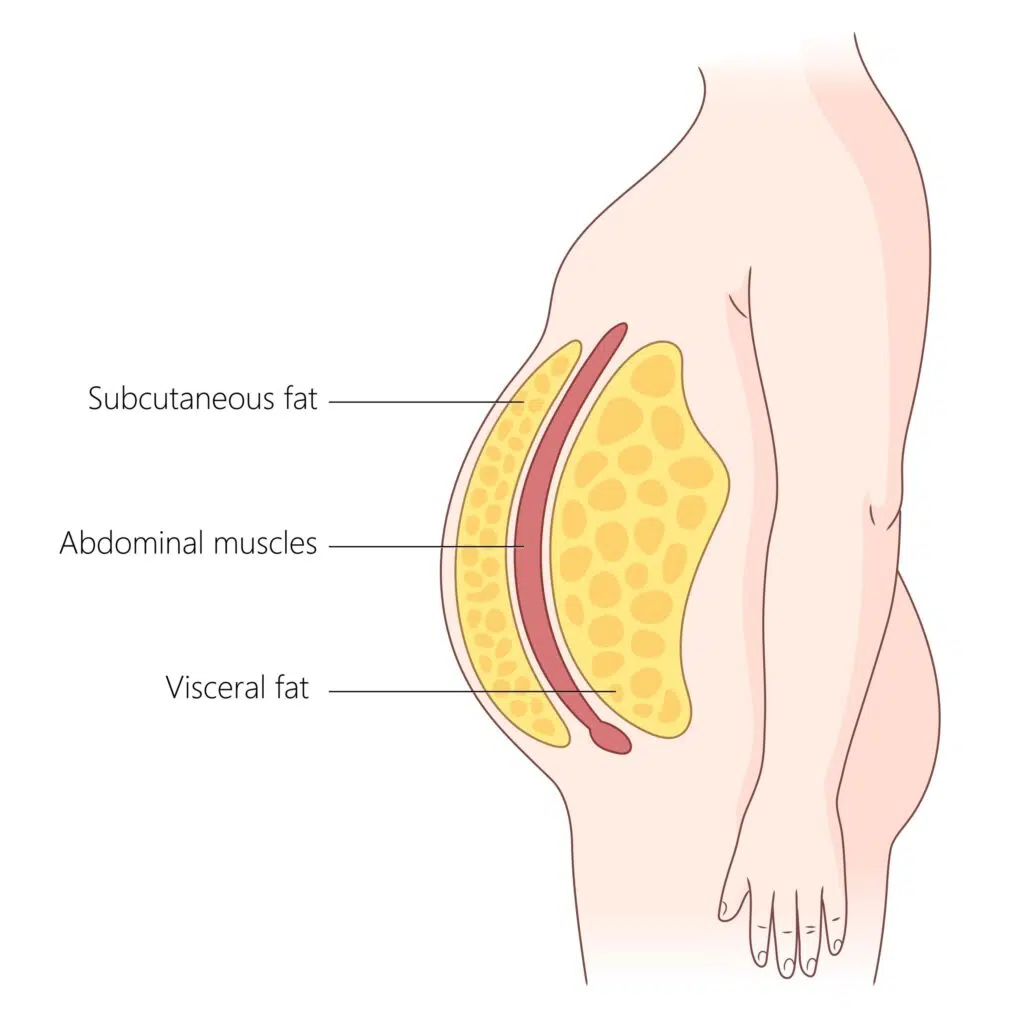
Visceral fat sits inside your abdominal cavity, wrapped around your liver, intestines, and pancreas. It is metabolically active in a way that subcutaneous fat — the fat just under your skin — is not. The cardiometabolic risk it carries is the part of body composition that predicts decline most directly.
For Singapore adults, this matters more than most people realise. Asian adults carry more visceral fat at any given BMI than Caucasian adults do. That is why standard BMI thresholds systematically underestimate cardiometabolic risk in our population.
Here is what visceral fat actually is, why it is uniquely dangerous, how to measure it, and — most importantly — how it responds to training.
What Visceral Fat Actually Is
Adipose tissue exists in two anatomically and physiologically distinct compartments. Subcutaneous fat sits between the skin and the muscle layer. Visceral fat sits inside the peritoneal cavity, wrapping around the abdominal organs.
The two compartments look similar under a microscope. They behave very differently in terms of metabolic activity and disease risk.
- Subcutaneous fat is the body’s primary long-term energy storage. It is relatively metabolically inert at rest, releases fatty acids slowly, and has a defensible biological role in energy reserve, thermoregulation, and mechanical cushioning.
- Visceral fat is densely innervated, well-vascularised, and continuously secretes signalling molecules directly into the portal circulation that feeds the liver.
Some of those signalling molecules are useful in healthy quantities, such as adiponectin. Most are inflammatory and harmful when chronically elevated, including tumour necrosis factor alpha, interleukin-6, and plasminogen activator inhibitor-1.
The portal-circulation route is the critical detail. Visceral fat dumps its signalling output straight into the liver, which then amplifies the systemic effects in ways subcutaneous fat simply cannot.
The practical translation: visceral fat is the part of body composition that drives the cardiometabolic disease cluster. Subcutaneous fat is the part that drives cosmetic concerns. The two often coexist, but they should never be conflated when the question is healthspan.
Why Visceral Fat Is Uniquely Dangerous
The inflammatory cascade from chronic visceral fat accumulation drives the three major cardiometabolic risk profiles.
- Insulin resistance leading to type 2 diabetes.
- Atherogenic dyslipidaemia — high triglycerides, low HDL, dense LDL particles — leading to atherosclerotic cardiovascular disease.
- Chronic systemic inflammation leading to a constellation of conditions including non-alcoholic fatty liver disease, polycystic ovary syndrome in women, and accelerated arterial ageing.
The Despres 2012 review in Circulation laid out the mechanistic case clearly. Visceral adiposity is not merely a marker of cardiometabolic disease — it is a driver. The inflammatory signalling from chronically expanded visceral adipose tissue produces the disease cluster directly.
Critically, reducing visceral fat reverses or attenuates much of the downstream pathology. This holds true even in adults who do not change their total body weight in the process.
Two adults can share an identical BMI and an identical total body fat percentage and still have completely different visceral fat profiles. The dangerous half of the body composition picture is invisible on a bathroom scale.
How to Measure Visceral Fat
Four methods exist, in declining order of accuracy.
Magnetic Resonance Imaging (MRI)
The research gold standard. MRI produces a direct anatomical image of visceral adipose tissue volume. It is expensive and used primarily in research settings rather than routine practice.
Dual-Energy X-Ray Absorptiometry (DEXA)
The clinical gold standard for body composition. DEXA distinguishes between subcutaneous and visceral fat with reasonable accuracy and reports an estimated visceral adipose tissue volume. Higher accuracy than bioimpedance, lower than MRI.
InBody Segmental Bioimpedance
The widely deployed clinical-grade bioimpedance method, used at RAW Active as part of our body composition analysis. It estimates visceral fat via segmental impedance analysis.
Accuracy against a DEXA reference is good for trend tracking but lower than DEXA itself for absolute measurement. The practical advantage is speed, no radiation exposure, and repeatability in the same studio under the same conditions every time.
Waist-to-Height Ratio (WHtR)
A tape measure and a calculator. WHtR is not a direct measurement of visceral fat, but it is the simplest field proxy with the strongest epidemiological evidence base.
The Ashwell 2012 meta-analysis pooled 31 studies and found WHtR consistently outperformed BMI in identifying cardiometabolic risk across populations.
- Keep your waist circumference below half your height.
- WHtR above 0.5 indicates elevated cardiometabolic risk.
- WHtR above 0.6 indicates high risk.
For most Singapore adults pursuing healthspan, WHtR plus an InBody scan is the practical combination.
The Singapore Picture: Why BMI Alone Misleads
Asian adults in general carry more visceral fat per unit of total body weight than Caucasian adults. The published evidence base is consistent across multiple studies.
The Health Promotion Board adopted lower BMI cutoffs — 23.0 for elevated risk and 27.5 for high risk — specifically to reflect this. The clinical implication is direct: a Singapore adult with a BMI of 24 is not at the same cardiometabolic risk as a Caucasian adult with the same BMI.
The Singapore adult almost certainly carries more visceral fat per kilogram of body weight.
What we see across the 45 to 60 executive demographic in our studio is consistent. The modal Singapore adult presents with a BMI in the 22 to 25 range — normal-looking on a Western standard — but visceral fat measurement on InBody often shows readings corresponding to elevated cardiometabolic risk. Waist circumference relative to height confirms it.
The Western reference standards were not designed for this population. They underestimate the risk profile.
The practical workflow: measure WHtR monthly with a tape measure, measure InBody visceral fat quarterly at minimum, and treat BMI alone as inadequate for cardiometabolic risk assessment. Visceral fat is what predicts decline. BMI just predicts which trousers fit.
How Visceral Fat Responds to Training
The good news embedded in the visceral fat story is the training response. Visceral fat is unusually responsive to structured exercise, particularly resistance training and moderate-intensity cardiovascular work combined.
The Vissers 2013 systematic review pooled 35 studies on exercise interventions and visceral adipose tissue. It found that 12 to 16 weeks of structured training reliably reduces visceral fat mass by 10 to 20 percent in previously untrained adults, often without comparable changes in subcutaneous fat or total body weight.
That asymmetric response matters enormously. It explains why some adults complete a training cycle, see no change on the bathroom scale, yet show meaningful improvements on InBody visceral fat estimate and on cardiometabolic blood markers.
The visceral fat went down. The subcutaneous fat stayed similar. The total weight barely moved. The cardiometabolic risk profile improved substantially — and the bathroom scale missed the relevant change entirely.
The Protocol That Produces the Largest Response
Two resistance training sessions per week plus two Zone 2 cardiovascular sessions per week, sustained for 12 to 16 weeks. That is the combination that produces the largest visceral fat response per unit of training stress.
High-intensity intervals that drive VO2 max gains also contribute to visceral fat reduction, but produce diminishing returns past one session per week.
The strength training piece is essential, not optional. Resistance training drives skeletal muscle glucose disposal capacity, which directly impacts the insulin signalling that visceral fat disrupts. The training framework for adults over 40 covers this in more detail.
The Healthspan Pillars Behind Visceral Fat Risk
Visceral fat does not operate in isolation. It sits at the centre of a cluster of measurable markers that together determine how long — and how well — you live. These markers are the KPIs of healthspan, and every one of them is trainable.
1. VO2 Max: The Currency of Longevity
VO2 max measures how efficiently your body uses oxygen during physical exertion. It reflects cardiovascular capacity, aerobic endurance, and mitochondrial efficiency, making it a leading predictor of both life expectancy and disease resistance.
Cardiorespiratory fitness is a stronger predictor of mortality than smoking, hypertension, and diabetes (Mandsager et al., 2018). Individuals maintaining 35 mL/kg/min or above have a 75 percent lower risk of premature death compared to those below 25 mL/kg/min.
- Below 20 mL/kg/min: danger zone.
- 25–30 mL/kg/min: functional health zone.
- 35+ mL/kg/min: longevity zone.
Unlike most biological outcomes, there is no upper limit to the benefit. At some point too little body fat is harmful and too much muscle mass carries a cost — but progressively raising your cardiorespiratory ceiling only extends life. Learn more in our guide to cardiovascular fitness.
2. Lower Body Power: The Most Overlooked Predictor
Strength is the ability to produce force. Power is the ability to exert that force quickly. Unlike strength, which declines gradually with age, power deteriorates rapidly starting in our 30s and accelerates thereafter.
Power declines two to three times faster than strength with ageing (Skelton et al., 1994; Reid & Fielding, 2012). Lower extremity power is more predictive of physical performance than strength or aerobic capacity (Bean et al., 2002).
Power is strength expressed under time pressure — preventing a fall, catching yourself on stairs, playing with your kids, reacting to a loss of balance. The research is striking: leg power is independently associated with mortality risk even when controlling for age, body mass and activity levels (Metter et al., 2002).
There is also a brain connection. A study of 324 female twins over ten years found that participants with more leg strength exhibited greater cognitive functionality than their twin.
3. Grip Strength: The New Vital Sign
Grip strength is a surprisingly robust predictor of long-term health. It measures neuromuscular integrity and correlates with cardiovascular function, hormonal health, and cognitive decline.
- Each 5 kg decrease in grip strength is associated with a 16 percent increased risk of all-cause mortality (Leong et al., 2015).
- A 1 kg increase in grip strength reduced all-cause mortality risk by 3.2 percent (Jeong et al., 2023).
- Low grip strength is linked with poorer cognition and higher dementia risk in older adults.
Grip strength is increasingly recognised as a “new vital sign” for health and longevity. It reflects systemic ageing and physical reserve, not just hand function.
4. Muscle Mass: The Engine of Metabolic Health
Muscle is not just for strength or aesthetics. It is one of the most powerful regulators of metabolism, glucose control, and longevity.
Skeletal muscle is responsible for roughly 80 percent of postprandial glucose uptake (Merz & Thurmond, 2020). It is the primary site for glucose disposal and a major driver of insulin sensitivity.
During ageing, approximately 30 percent of peak muscle mass is lost by the age of 80 (Frontera & Ochala, 2015). Loss of muscle is one of the strongest predictors of frailty, disability, and early mortality.
5. Bone Health: The Structural Foundation
Bone is living tissue that constantly remodels in response to load, stress, and movement. Bone adapts to mechanical force, and bone health predicts both fracture risk and mortality.
Fracture risk is a life event, not an inconvenience. The first fracture predicts the next — the “fracture cascade” — and hip fracture carries high morbidity and mortality.
Strong bones prevent fractures but not falls. That is why bone health and power training belong in the same programme.
6. Inflammation: The Silent Driver of Ageing
Chronic, low-grade inflammation underlies cardiovascular disease, metabolic dysfunction, neurodegeneration, and accelerated ageing. It is one of the strongest predictors of disease and decline.
Inflammation is not inherently bad. It is the body’s repair and defence programme. The healthspan problem is chronic low-grade systemic inflammation — the state described as “inflammaging.”
Inflammation-related diseases contribute to more than 50 percent of global deaths (Furman et al., 2019). This is precisely the mechanism through which visceral fat exerts its damage.
How Whole Body Vibration Amplifies the Response
At RAW Active, we use Power Plate whole body vibration (WBV) as a signal amplifier. It does not replace strength training. It amplifies access to the training qualities that matter most for healthspan, particularly when traditional methods are limited.
WBV and Cardiorespiratory Fitness
WBV consistently increases VO2 both during and after exercise across different populations and settings. A 30-minute WBV session increased VO2 by 23 percent compared to the same session without vibration, with elevated oxygen uptake persisting for up to 24 hours post-exercise (Hazell & Lemon, 2011).
Research from the University of Greenwich found that adding mechanical vibration to cycling produced significant linear increases in VO2 and heart rate at each cadence, and reduced the time to reach peak VO2 from 13–14 minutes to 11 minutes.
Other studies support the pattern: WBV squats are a moderate-to-vigorous intensity exercise that effectively raises oxygen consumption (Qaio et al., 2025), and WBV interventions have improved VO2 max and body composition in young adults (Taiwo et al., 2023).
WBV and Lower Body Power
WBV is one of the most accessible, evidence-based ways to train power across the lifespan.
- Older adults: WBV combined with resistance training increased lower limb extension strength and jump height (Torvinen et al., 2002).
- Untrained females: a 24-week WBV programme improved knee extensor strength by up to 24.4 percent, comparable to resistance training (Roelants et al., 2004).
- Postmenopausal women: an 8-month programme combining WBV and resistance training produced greater strength increases than resistance training alone (Bemben et al., 2010).
- Explosive strength: short-term WBV applied during squat training improved rates of force development (Lamont et al., 2010).
The absence of power training is the greater risk. Fear of injury has kept power work out of most adult programmes — but the research shows the opposite of what people assume.
WBV and Grip Strength
WBV activates the sensory-motor loop, stimulating mechanoreceptors, muscle spindles, and cortical networks that support grip and postural integrity. In older adults, WBV enhanced grip strength and physical fitness, positioning it as an alternative to resistance exercise for strength improvements (Chang et al., 2018).
WBV and Bone Density
Bone requires load, rate, and repetition over time. WBV acts as a signal amplifier for osteogenic loading — mechanical strain high enough versus habitual levels to trigger bone adaptation.
- Hip BMD: a 6-month WBV programme improved hip bone mineral density and muscle strength in postmenopausal women (Verschueren et al., 2004).
- Femoral neck BMD: after 8 months, WBV increased femoral neck BMD by approximately 4.3 percent versus walking, and improved balance (Gusi et al., 2006).
- Meta-analysis: pooled analysis found WBV significantly increased hip BMD in postmenopausal women (Slatkovska et al., 2010).
The principle for bone is not chasing more volume. It is chasing a better signal — enough intensity and strain rate, plus smart dosing and recovery, to keep bone responsive.
WBV and Anti-Inflammatory Signalling
Contracting skeletal muscle acts like an endocrine organ, releasing signalling molecules called myokines. Exercise drives an anti-inflammatory cascade and downstream improvements in insulin sensitivity (Petersen & Pedersen, 2005; Pedersen, 2006).
WBV and REV intervals act as mechanical and metabolic signal amplifiers. Research shows WBV improved anti-inflammatory status in older adults with favourable shifts in inflammatory markers (Rodriguez-Miguelez et al., 2015), increased circulating stem and progenitor cell markers (Jawed et al., 2020), and influenced CRP and cytokine responses across populations (Moreira-Marconi et al., 2022; Wang et al., 2024).
This is the mechanism that connects directly back to visceral fat. Movement is one of the most powerful anti-inflammatory signals in the body — and it is the reason visceral fat responds to training at all.
Putting It Together: A Weekly Protocol for Visceral Fat and Healthspan
The training that reduces visceral fat is the same training that raises VO2 max, builds power, preserves muscle and bone, and regulates inflammation. There is no conflict between them.
- Two resistance training sessions per week. Compound movements, progressive overload, and isometric loading on the Power Plate to amplify tension and recruitment.
- Two Zone 2 cardiovascular sessions per week. Steady, conversational-pace work that builds aerobic base without excessive recovery cost.
- One power session per week. WBV-assisted explosive work, isometrics, and loaded movement with velocity.
- Daily movement. Walking, stairs, and general activity — the foundation that supports everything else.
- Recovery discipline. Seven to nine hours of sleep, protein at 1.6–2.2 g per kilogram of bodyweight, and planned deload weeks.
Sustain this for 12 to 16 weeks and re-measure. Not the scale — the InBody visceral fat estimate, the waist-to-height ratio, the strength numbers, and the cardiovascular markers. Those are the numbers that actually move.
Frequently Asked Questions
Can I Have High Visceral Fat at a Normal Weight?
Yes, and it is more common in Singapore-resident adults than in Caucasian populations. The body type colloquially called “skinny fat” refers to adults at normal weight and normal BMI who carry disproportionately high visceral fat for their body size. Singapore adults at BMI 22 to 24 frequently fall into this pattern, particularly with sedentary office jobs. The cardiometabolic risk profile is materially elevated despite the bathroom scale looking unremarkable.
How Quickly Can I Reduce Visceral Fat?
Faster than most adults expect. The Vissers 2013 systematic review and subsequent interventional studies find that 12 to 16 weeks of structured resistance training plus moderate cardiovascular work reliably reduces measured visceral fat by 10 to 20 percent in untrained adults. The response curve is faster than the equivalent response for subcutaneous fat or total body weight.
Does Intermittent Fasting Reduce Visceral Fat?
Modestly, when combined with resistance training. The dominant driver is the resistance training and the caloric balance rather than the timing of meals. Intermittent fasting in isolation produces visceral fat reduction comparable to a continuous caloric deficit of the same magnitude. The combination that produces the largest response is structured resistance training plus a modest caloric deficit, with meal timing as a relatively minor variable.
What Is a Normal Visceral Fat Range?
On an InBody scan, visceral fat is reported as a level from 1 to 20. Most clinical guidance treats 10 and above as elevated risk. As a field proxy without a scan, keep your waist below half your height — a waist-to-height ratio under 0.5.
Do I Need Special Equipment to Train This Way?
No. Resistance training and Zone 2 cardio require minimal equipment. What WBV adds is efficiency and accessibility — it amplifies the power, bone, and anti-inflammatory signals that are hardest to train with conventional methods, particularly for adults over 40 or those returning from injury.
Measure It, Improve It, Track It
Visceral fat is the part of your body composition that predicts decline most directly — and it is also the part that responds most readily to structured training. The bathroom scale will not show you the change. A proper measurement will.
At RAW Active, we measure body composition, strength, and movement capacity, then build a plan around your actual numbers. Our personal training programme is flexible and built around your lifestyle, and we use Power Plate whole body vibration to amplify the training qualities that matter most for long-term health.
Do not wait for a health scare to start measuring what matters. Book a free consultation with us today and start training for the decades ahead, not just the next few weeks.