The Bulgarian split squat is one of the most efficient lower-body exercises you can do. It trains the quads, hamstrings, glutes, and calves in a deeply lengthened position, builds single-leg stability, drives up core demand, and exposes left-right imbalances that a regular squat hides. Done consistently, it builds real, usable strength that carries over to running, climbing stairs, lifting heavy objects, and protecting the knees for decades. This guide walks through form, muscles trained, benefits, common mistakes, regressions, progressions, programming, and FAQs so you can drop the lift into your weekly routine with confidence.
What Is a Bulgarian Split Squat?
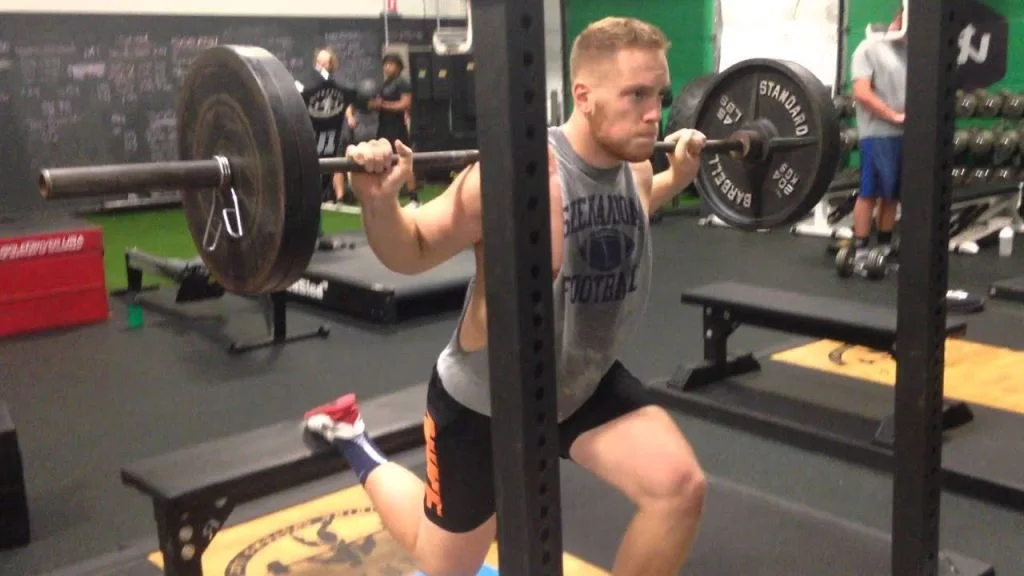
A Bulgarian split squat is a rear-foot-elevated single-leg squat. You stand a stride length in front of a bench, low box, or sturdy chair, reach one foot back, and rest the top of that foot on the surface behind you. From there, you lower the back knee toward the floor while bending the front knee, then drive back up through the front heel. Because the rear foot only balances rather than pushes, the entire working load sits on the front leg. That is the difference between this drill and a regular lunge, and that is what makes it so productive.
Step-by-Step Form Walkthrough
- Set up the bench. Use a stable bench, low plyo box, or sturdy chair. The surface should sit around knee height or slightly below. A bench that is too high forces the torso forward and overloads the front knee. A bench that is too low turns the drill into a regular lunge.
- Pick the stride. Step forward far enough that the front shin is roughly vertical at the bottom of the rep and the back knee can hover just above the floor. A short stride loads the quads more. A longer stride shifts more load into the glutes and hamstrings.
- Plant the back foot. Rest the top of the rear foot on the bench. Toes can point down or be neutral. Lacing the foot flat generally increases knee discomfort, so toes-down usually wins.
- Stack the front foot. Place the front heel firmly on the floor, foot pointing straight ahead or slightly out. Keep the knee tracking over the second and third toes throughout the rep.
- Brace the core. Take a breath, brace the abs as if preparing for a soft punch, and pin the ribcage down so the lower back stays neutral.
- Lower with control. Sit back and down, keeping the chest up and torso mostly vertical (slight forward lean is fine for a glute emphasis). Lower until the back knee is just above the floor or taps gently.
- Drive up through the front heel. Exhale near the top, repeat. Match reps exactly on each side.
Which Muscles Do Bulgarian Split Squats Work?
The Bulgarian split squat is a true multi-joint compound lift with surprisingly deep recruitment.
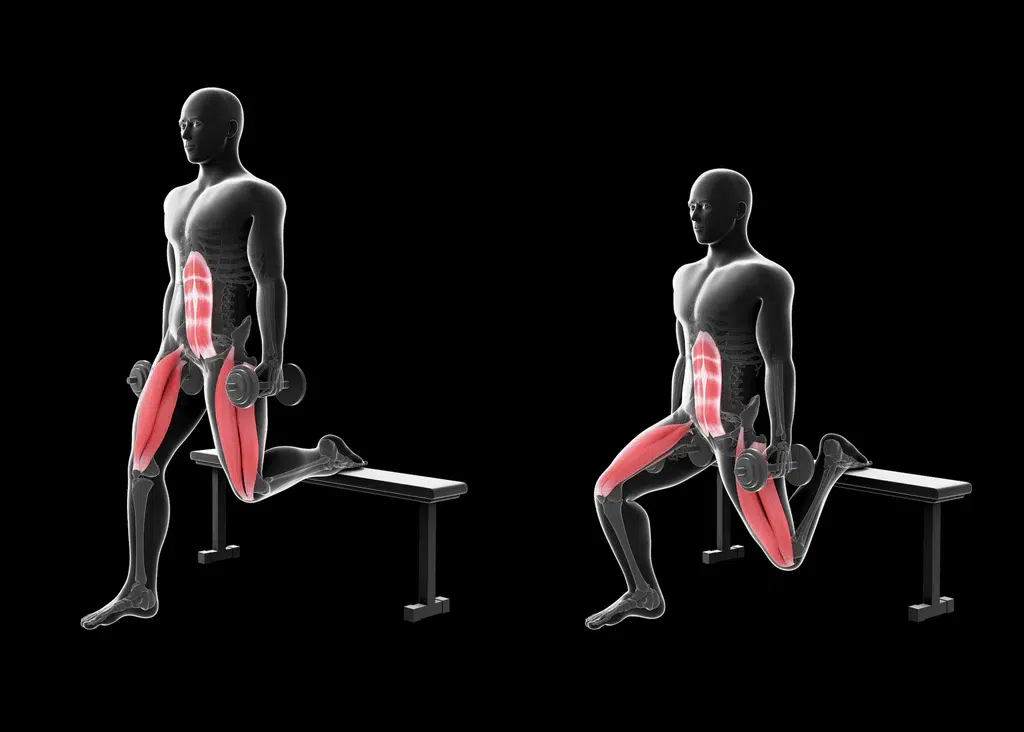
- Quadriceps: the dominant mover, especially the vastus lateralis and rectus femoris. The lengthened position under load is one of the strongest growth stimuli for the quads.
- Hamstrings: stabilise the knee and assist hip extension, particularly in the top half of the rep.
- Glutes: the gluteus maximus fires hard to extend the hip, more so with a longer stride and a slight forward torso lean.
- Adductors: the inner thigh stabilises the pelvis through the descent.
- Calves: the gastrocnemius and soleus work to stabilise the front foot and ankle.
- Core: the rectus abdominis, obliques, and erector spinae brace the trunk continuously. Anti-rotation and anti-extension demand rises with any extra load.
That mix of muscle recruitment is why the lift transfers so well to sports, daily life, and rehab work. For a deeper look at lower-body strength across the lifespan, see the importance of building muscle and strength.
Why Bulgarian Split Squats Belong in Your Routine
Single-leg work has gained momentum over the last decade because research and coaching experience keep showing that unilateral training corrects asymmetries, builds joint-friendly strength, and improves balance in ways bilateral squats cannot. The Bulgarian split squat is the most efficient version of that work.
Unilateral Strength and Imbalance Correction
Bilateral squats can hide left-right imbalances because the stronger leg quietly does more work. The Bulgarian split squat forces each leg to carry its own load, so any imbalance becomes visible within a few reps. Programming the lift twice a week for eight weeks usually evens out left-right strength, improves jump performance, and quiets nagging knee discomfort.
Joint-Friendly Strength for the Knees
Because the rear foot only acts as a balance point, the front knee handles load without the heavy compressive forces of a back squat. Lifters with sensitive knees often find Bulgarian split squats easier to tolerate than bilateral squats, especially when they stay at moderate loads and full ranges of motion. RAW Active’s rehabilitation programmes lean on this exact principle; for a broader view see best personal trainers for injury rehabilitation.
Functional Strength That Transfers
Walking, running, climbing stairs, stepping off a kerb, picking up a child, and getting out of a chair are all single-leg tasks. Training the Bulgarian split squat builds specific strength for those exact movements. For a wider take on functional versus traditional strength work, the strength training in Singapore overview is a useful complement.
Cardiovascular and Calorie Demand
Single-leg work raises heart rate faster than bilateral work for the same volume. A solid set of Bulgarian split squats can push heart rate into the moderate-intensity zone, which means the lift doubles as light cardio. For how daily low-intensity movement stacks with training to support fat loss, see NEAT and energy balance.
Core Stability
The unsupported rear foot forces the core to work continuously. Anti-rotation, anti-extension, and anti-tilt all run at the same time. Many lifters find Bulgarian split squats more core-draining than bilateral squats, which is why the lift often appears in core-focused programmes alongside five best core exercises.
Adaptable Load and Scalable Difficulty
Bodyweight to begin. Dumbbells or kettlebells in each hand to progress. A barbell on the back or in a front rack for advanced lifters. The lift scales from absolute beginner to elite lifter without changing the basic pattern.
Bulgarian Split Squats for Lower-Body Hypertrophy and Functional Exercise
Hypertrophy requires mechanical tension, metabolic stress, and progressive overload. The Bulgarian split squat delivers all three. The lengthened position under load creates high mechanical tension across the quads and glutes. The single-leg format creates significant metabolic stress because cardiovascular demand climbs with each rep. Progressive overload happens naturally as you add reps, sets, or load across weeks.
For the broader hypertrophy framework, see the RAW Active strength training guide. For aesthetic and body-composition goals, see female body fat percentage and exercise and reverse aging for how strength reshapes the body across decades.
Common Mistakes and How to Fix Them
- Bench too high. Forces the torso forward, loads the front knee, and reduces quad recruitment. Lower the bench to around knee height.
- Stride too short. The front knee shoots past the toes, the back knee barely lowers, and the front quad cramps. Step out farther.
- Stride too long. The torso folds forward and the low back takes over. Step in slightly and keep the chest tall.
- Knee collapsing inward. The front knee drives medially, loading the MCL. Actively push the knee out toward the pinky toe.
- Heel lifting off the floor. Loses quad engagement. Push through the heel and keep the foot flat.
- Rear foot laces flat. Often irritates the front of the ankle and toes. Drop the toes downward.
- Skipping core bracing. The lower back dominates the movement. Brace the abs and pin the ribcage down.
- Mismatched reps per side. Left-right drift hides imbalances. Pause briefly and match reps exactly.
Regressions: Easier Variations for Beginners
- Bodyweight split squat with no bench. Drop the rear foot on the floor first to learn the pattern.
- Lower the bench height. Use a step or even a stack of plates until range and strength improve.
- Hold a wall or door frame for balance. Reduces stability demand while you lock in the technique.
- Use shorter range of motion. Stop the descent at half-depth and build up to full depth over weeks.
- Reduce sets and reps. Start with 2 sets of 6 reps per side, then build up.
Progressions: Harder Variations When You Are Ready
- Add dumbbells or kettlebells. Hold them at the sides, in a goblet position, or in a rack position for more core demand.
- Add a barbell. Back-loaded, front-loaded, or landmine variations all work. For programming details, see strength training in Singapore.
- Pause at the bottom. Hold for 2 to 3 seconds before driving up. Builds strength at the most challenging joint angle.
- Slow eccentric. Take 3 to 4 seconds to lower. Increases time under tension and hypertrophy stimulus.
- Elevate the front foot. Step onto a small plate to push range of motion deeper.
- Combine with a reach or rotation. Adds anti-rotation core work and sport-specific carryover.
Sample Programming
Beginner (Weeks 1 to 4)
- Frequency: twice a week.
- Sets and reps: 3 sets of 8 reps per side, bodyweight or light dumbbells.
- Rest: 60 to 90 seconds between sides.
- Progression: add 2 to 3 kg per week on each dumbbell when all reps are crisp.
Intermediate (Weeks 5 to 12)
- Frequency: twice a week.
- Sets and reps: 3 to 4 sets of 8 to 12 reps per side with moderate dumbbells.
- Rest: 90 seconds between sides.
- Progression: add a set, then add reps, then add load in that order.
Advanced (Weeks 13+)
- Frequency: once or twice a week.
- Sets and reps: 4 sets of 6 to 10 reps per side with heavy dumbbells or a barbell.
- Include tempo work: 3 seconds down, 1 second pause, 2 seconds up.
- Pair the lift with accessory single-leg work such as single-leg Romanian deadlifts and step-ups.
For how Bulgarian split squats slot into a wider weekly plan, see fitness routine, the broader 10 reasons to train in proper exercise form, and the strength training before or after cardio guide for sequencing.
Pairing Bulgarian Split Squats With Other Movements
- Single-leg Romanian deadlift: cleans up hamstring and glute synergy on the same leg.
- Step-up: reinforces single-leg push strength at a different angle and range.
- Sled push or sled march: builds unilateral endurance and conditioning.
- Walking lunge: transitions Bulgarian split squat strength into continuous stride work.
- Hip thrust or glute bridge: rounds out hip-dominant strength on the same days.
- Core circuit: dead bugs, side planks, and Pallof presses complement the lift’s anti-rotation demand.
Who Should Be Careful With Bulgarian Split Squats
- Lifters with acute knee injuries should clear the drill with a sports therapist first. The rehabilitation trainer guide explains how to coordinate therapist and trainer input.
- People with severe ankle mobility restrictions may struggle to keep the front heel grounded. Work on ankle mobility first.
- Beginners with poor balance should use a wall or doorway for support until stability improves.
- Anyone returning from lower-back injury should keep load light and range modest until a coach clears heavier work.
- Pre- and post-natal clients should run the drill at low load with a coach present. Guidance sits in pre and post-natal fitness.
Bulgarian Split Squats in Popular Programming Styles
- Strength blocks: 4 to 6 sets of 4 to 6 reps per side with heavy dumbbells or a barbell.
- Hypertrophy blocks: 3 to 4 sets of 8 to 12 reps per side with moderate load and shorter rest.
- Stability and rehab blocks: 2 to 3 sets of 10 to 15 reps per side with light load, slower tempo, and a focus on knee tracking.
- Holiday or travel-friendly mini programmes: bodyweight Bulgarian split squats paired with push-ups, rows, and core work. See the Christmas workout for an example session.
- Home workouts: use a chair, sofa, or stack of books as the rear-foot target. See create your own home workout plan.
Hydration, Recovery, and the Lift
Single-leg drills raise core temperature, heart rate, and sweat rate faster than bilateral work. Hydration before, during, and after the session affects performance and recovery. The RAW Active fitness and hydration guide lays out practical intake numbers for working adults in Singapore’s climate. Sleep, hydration, and protein together support the muscular repair the lift demands. See personal training and nutrition for the full integration. For seniors who want to keep the lift in their routine, the enhancing senior fitness page adapts the drill for older adults.
Bulgarian Split Squats for Different Goals
- Fat loss: high-rep Bulgarian split squats paired with walking raise daily energy expenditure. Layer that with smart nutrition choices around cheat days for sustainable results.
- Muscle gain: load Bulgarian split squats progressively within a structured strength programme like the RAW Active Great World City personal training template.
- Sport performance: unilateral strength transfers directly to agility, sprinting, and change of direction. Lifters in HYROX-style conditioning work in particular benefit from the lift.
- General health: the lift preserves muscle mass, balance, and bone density in adults over 40. Progressions sit in senior fitness.
- Women’s strength: unilateral work is especially useful for hip stability, pelvic alignment, and bone density. See benefits of strength training for women’s health.
How RAW Active Programmes Bulgarian Split Squats
RAW Active coaches programme the lift twice a week for most clients because the unilateral demand complements bilateral squat, deadlift, and press work without overloading any one joint. The first four weeks focus on technique and balanced reps. From week five, load increases in small steps. By week eight, most clients have matched left-right strength, reduced knee discomfort, and added measurable kg to their dumbbells. The studio environment at Orchard Towers is structured for exactly this kind of focused training. Read choosing the perfect gym, personal training as an essential service, and RAW Active personal training for the broader context.
For lifters who want to pair Bulgarian split squats with upper-body pulling work for balance, the incline pull-ups drill is a strong complement. For the broader principles behind mixed strength sessions, see physical training.
Final Takeaways
The Bulgarian split squat is one of the most efficient lower-body drills you can add to your training week. It builds quad, hamstring, glute, and calf strength in a lengthened position, demands serious core work, exposes left-right imbalances, and scales from beginner bodyweight to advanced barbell load. Done twice a week with progressive overload and good technique, it pays back in knee-friendly strength, better balance, and improved athletic performance for years.
Frequently Asked Questions
What does a Bulgarian split squat work?
The lift targets the quadriceps, hamstrings, glutes, calves, adductors, and core. The quads are the dominant mover because the rear foot only acts as a balance point, not a pusher. Hamstrings and glutes assist hip extension. The core works continuously for stability.
Are Bulgarian split squats better than regular squats?
Neither lift is universally better. Bilateral squats allow heavier absolute load, while Bulgarian split squats offer deeper single-leg strength, better balance work, and clearer imbalance correction. Most well-rounded programmes include both.
How high should the bench be?
The bench should sit around knee height or slightly below. A bench that is higher forces the torso forward, overloads the front knee, and reduces quad recruitment. A standard gym bench works well for most adults.
How long should you wait between sets on Bulgarian split squats?
Beginners benefit from 60 to 90 seconds of rest. Intermediate lifters usually rest 90 seconds to 2 minutes. Heavy strength work may need 2 to 3 minutes between sides to keep technique crisp.
Why does my front knee hurt during Bulgarian split squats?
Common causes include a bench that is too high, a stride that is too short, the knee collapsing inward, or load that is too heavy. Lower the bench, step farther forward, push the knee out toward the pinky toe, and reduce load until technique is clean. Persistent pain warrants a sports therapist check.
Can beginners do Bulgarian split squats?
Yes. Beginners start with bodyweight, a lower bench, a wall for balance if needed, and a shorter range of motion. Two sets of 6 reps per side is a strong starting point.
How heavy should Bulgarian split squats be?
Heavy enough to challenge the last 3 reps of a set without breaking form, but light enough that the first rep looks identical to the last. Most lifters start around 4 to 8 kg per hand and build up over months.
Are Bulgarian split squats good for fat loss?
Yes. They raise heart rate, burn significant calories, and preserve or build lean mass. Pair them with daily walking, smart nutrition, and adequate sleep for the best results.
Are Bulgarian split squats good for runners?
Yes. Single-leg strength, balance, and hip control all transfer to running economy and injury resistance. Pair them with calf work, hip stability drills, and progressive mileage.
How many times a week should I do Bulgarian split squats?
Most lifters do the drill twice a week. Three times is possible for advanced lifters but requires careful recovery management. Once a week is enough for general maintenance if combined with other strength work.
Can I do Bulgarian split squats at home?
Yes. Use a chair, sofa, or stack of books for the rear foot. Hold dumbbells, water jugs, or a backpack for load. The RAW Active home workout plan explains how to structure a full session.
What muscles should I train alongside Bulgarian split squats?
Pair the lift with single-leg Romanian deadlifts, step-ups, calf raises, hip thrusts, and core work. For a balanced weekly split, see fitness routine and strength training in Singapore.
Are Bulgarian split squats safe during pregnancy or post-partum?
Only with explicit clearance from a doctor and a qualified coach. Use bodyweight or very light load, a wider stance, and stop at the first sign of discomfort. Specific guidance sits in pre and post-natal fitness.
How can RAW Active help me add the lift to my programme?
RAW Active personal trainers programme Bulgarian split squats alongside bilateral work, run technique reviews every four weeks, and adjust load based on InBody scan data, sleep, and recovery. Book a free trial through the RAW Active personal training page to get started.