Your core is the engine room of the body. Every lift, every run, every carry, every rotation pulls stability from it first. If the engine room is weak, the rest of the body compensates. Compensation is what eventually shows up as back pain, hip pain, poor posture, or slower progress on every other lift you care about.
The five exercises below are the ones RAW Active coaches use to build a strong, stable core. They are simple enough for beginners, scalable enough for serious lifters, and small enough to fit in a home workout. We have reorganised the original RAW Active article into a clearer structure with cues, sets and reps, common mistakes, and progressions. Use the order below for your first 8 weeks.
What Is Core Training?
Targeted strengthening and stabilisation of the core muscles is referred to as core training. The transversus abdominis, external and internal obliques, rectus abdominis, and pyramidalis make up the majority of these core muscles. The spine is supported and shielded by these muscles.
Moreover, the core serves as the connector between the upper and lower bodies. For a body to be healthy, it is crucial to have a strong and flexible core. With core training, lower back discomfort in particular can be managed. Relieving lower back pain starts with restoring core stability before chasing any single weak muscle.
Muscle strength gains of any size have a significant impact. The general strength of the trunk is boosted by intra-abdominal pressure, which supports stability. The abdominal muscles are primarily contracted to do this. Additionally, current research indicates that this mechanism also involves the diaphragm and the often-misinterpreted pelvic floor muscles.
Prior to the initiation of any limb movement, these muscles contract. The trunk is now ready for use. It is also worth noting that simply activating these muscles 5 to 10 percent more will strengthen the spine for both everyday activities and strenuous jobs.
Why core training changes more than your abs
- Posture improves. A strong core holds the ribcage over the pelvis, which directly affects how you stand and sit.
- Breath gets easier. The diaphragm works with the abdominal wall. Training both sides together improves posture-side breathing.
- Movement gets faster. Power transfers from the upper body to the lower body through the core, which is the difference between climbing movements that feel smooth and ones that feel heavy.
- Body composition improves. Core training feeds into the muscle guarding effect of sculpt body work.
Which Muscles Belong to the Core?
The core of the human body is located in the region between the upper and lower bodies. The muscles that surround this core are those that make up the core. Parts of the gluteal and thigh muscles, as well as the back and abdominal muscles, play a role in this. The core muscles’ primary job is to transfer power from the upper to the lower body in addition to stabilising and moving the spine.
The transverse abdominis, multifidus, internal and external obliques, erector spinae, diaphragm, pelvic floor muscles, and rectus abdominis are the muscles that specifically contribute to core stability. Your lats, traps, and glutes are some of your accessory core muscles, and they matter too.
The trunk complex is propelled by the massive, superficial abdominal and hip muscles. They contribute the most to the hips and torso having enough strength to withstand rotational forces pressing on the body. Yet the smaller, intrinsic muscles that run along the spine help support and rotate the spine. The five exercises below call on both layers.
Core muscles, in plain language
- Transverse abdominis. The deep corset that holds the organs in and the spine steady.
- Rectus abdominis. The “six-pack” muscle you see, important for trunk flexion.
- Internal and external obliques. The side muscles that handle rotation and anti-rotation.
- Erector spinae. The lower back muscles that extend and stabilise the spine.
- Multifidus. Small spine stabilisers that often need targeted work after injury.
- Diaphragm and pelvic floor. Breathing and pressure regulation, often missed in core training.
Who Can Benefit From Core Training?
Everyone should engage in core training. Strengthening the body’s inherent stabilising muscles benefits daily activities as well as athletic performance. We frequently make actions like bending, gripping, and rotating. Even hard-training athletes don’t want to risk injuring their back while picking something up off the floor. Although injuries can happen, the risk of an injury from a routine task is substantially lower if the core is kept strong.
Who benefits most
- Office workers. Hours of sitting weaken the deep stabilisers. Core training reverses it.
- Adults over 40. Balance and back support decline with age. Senior fitness programmes put core work first.
- Runners and lifters. Core strength transfers into athletic performance and hydration tolerance.
- Postnatal women. The deep core and pelvic floor need a structured rebuild before high-intensity work.
- Anyone returning from back pain. A step-by-step core plan is the safest re-entry path.
How Do You Train the Core?
The best way to train core strength is to use a mixture of dynamic and isometric exercises for the abdominal muscles, back muscles, and glutes. Different rep ranges should be used, and trained both with and without weight. In contrast to other sports, core training through velocity-based training does not only involve simple stretching and bending movements. Instead, sit-ups and similar moves are integrated into special movement sequences within an exercise.
As mentioned, the following muscle groups are central to core training: back muscles, abdominal muscles, hamstrings, glutes, and hip rotators. Exercises in the area of core training can best be done with your own body weight. This variant is particularly suitable for beginners and seniors and can be carried out both in the gym and at home without any problems.
Hence, it is important to add core-focused exercises that will condition your muscles. Here are some of the best core exercises that you can perform at your local training facility with little supervision. These are some ab workouts for beginners other than the traditional planking. Time to work those muscles.
A simple weekly core plan
- Day 1: Tabletop Leg Press + Plank, 3 rounds total.
- Day 2: Bird Dog, 3 sets of 10 reps per side.
- Day 3: Rest or a 20-minute walk.
- Day 4: Side Plank Dip + Cable Wood Chop, 3 rounds total.
- Day 5: Bird Dog (light) + Plank regressions.
- Day 6 to 7: Rest or light aerobic work.
Best Core Exercise #1: Tabletop Leg Press
The transverse abdominal muscles, which are frequently deep and difficult to reach with other forms of training, are trained in the core abdominal areas of the Tabletop Leg Press. If you have back issues, this is one of the finest core workouts to perform.
How to do it
- Step 1: Start by lying on your back with your legs raised to a 90-degree angle.
- Step 2: Squeeze your stomach muscles together to push your lower back into the ground. Put your hands on the front of your quads after slightly crunching up.
- Step 3: Press your quads away while driving them into your palms. Before returning to the starting position with your back flat on the ground, hold that position for six seconds.
Aim for 3 sets of 10 repetitions. Keep in mind that it is functioning if you feel the strain in your core. If you feel the strain in your neck, your ribcage is flaring, drop the crunch and breathe out as you press.
Common mistakes
- Letting the lower back arch off the floor.
- Pressing the hands hard instead of the abs. The hands only resist lightly.
- Holding the breath. Breathe slowly out on the press, in on the reset.
Regressions and progressions
- Regression: Drop one leg at a time to the floor and back, alternating sides.
- Progression: Lower both heels to within an inch of the floor, hover, then drive back up.
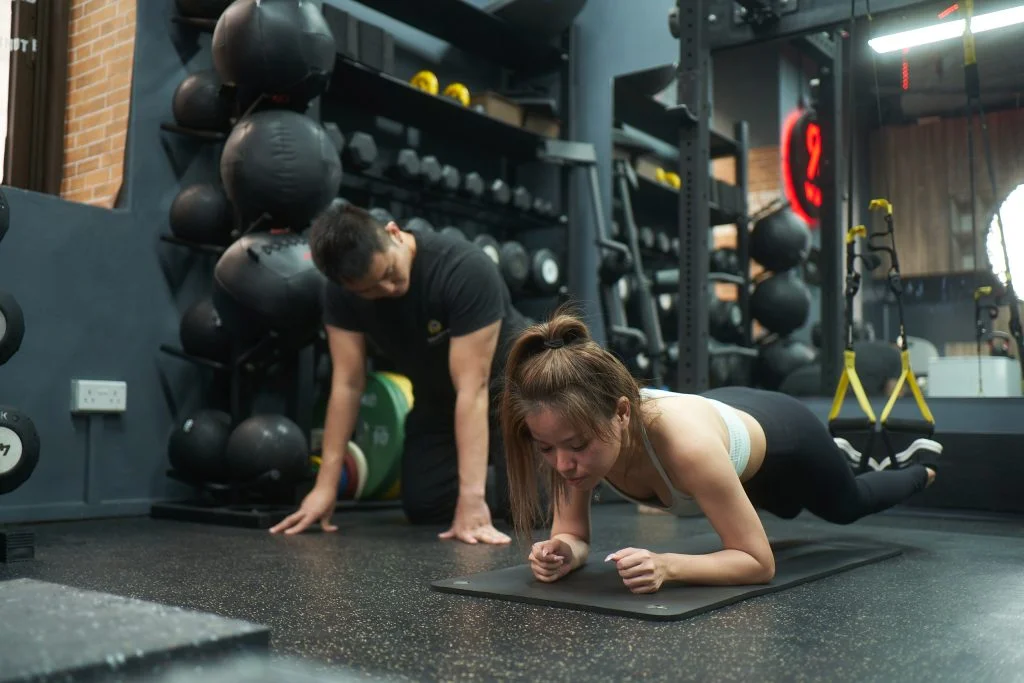
Best Core Exercise #2: Plank

One of the best core workouts you can perform is the plank. It is incredibly simple and efficient for core training. It is the ideal complement to any full-body exercise.
How to do it
- Step 1: Align your elbows so they are directly below your shoulder blades, or you can regress by making your arms straight. Make sure your upper body is straight and parallel to the ground. Make sure your arms aren’t too far apart because doing so could injure your back.
- Step 2: Keep your feet hip width. Maintain a straight posture from head to toe. This is a pose that resembles a push-up. Imagine putting your shoulder blades within the pockets of your pants by tucking them together.
- Step 3: Apply pressure and squeeze to your glutes and the front of your thighs. You shouldn’t experience any back pain when done correctly. The plank is designed to train your core muscles, which are located behind your back.
- Step 4: Now, contract your abdominal muscles as if in a reflex to absorb a hit. This will put pressure on the lower abdomen.
Starting off, hold plank positions for 2 to 3 seconds for 10 repetitions in sets of 2 to 3, then gradually advance as you gain more assurance. Planking is not a passive position, as beginners sometimes believe, as the steps above show. The exercise works the back, shoulders, and abdominal areas, among other body parts involved in core training.
Common mistakes
- Sagging the hips so the lower back takes over.
- Piking the hips so high that the core disengages.
- Holding the breath. The brace is your breath stacked under tension, not a held breath.
- Looking up. Keep the gaze on the floor so the neck stays long.
Regressions and progressions
- Regression: Drop to the knees and keep the line from knees to shoulders.
- Progression: Move to the side plank, which strengthens the flank muscles.
Best Core Exercise #3: Bird Dog Exercise
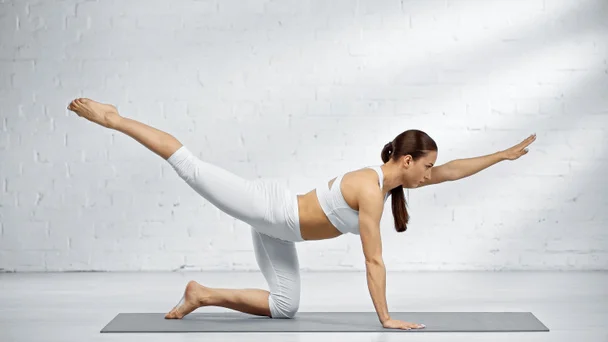
Your lower back pain can be greatly reduced by performing the Bird Dog workout. Your back, hips, and core muscles will all get stronger from performing this exercise. It is a beneficial workout that will aid in your efforts to adopt healthy posture and extend your range of motion.
How to do it
- Step 1: Set up for this exercise by placing your hands and knees below your shoulders. Make sure your back is positioned correctly. By keeping your spine in a neutral position, you’ll be able to effectively perform this exercise by using your abdominal muscles.
- Step 2: Raise your left leg and right arm off the ground. Make sure your shoulders and hips are parallel to the floor while you perform this. Remain in this position for a short while, then switch back to your starting position.
- Step 3: Repeat step 2 on the left side. This counts as one round.
Aim for three sets of 10 repetitions, with 5 repetitions on each side, for the best results. Bird Dog can be hard to do, so if you are new to this exercise, you can start off by extending just one leg at a time to work on your stability. Once you have achieved this, you may progress to extending your opposite arm at the same time as your leg.
Common mistakes
- Rotating the hips when the arm and leg move. Keep the pelvis square to the floor.
- Arching the lower back at the top of the move.
- Swinging the limb up fast. Move slowly, pause, then return.
Regressions and progressions
- Regression: One limb at a time, slow tempo, 3-second hold at the top.
- Progression: Add a small dumbbell in the extended hand, or perform a set of 10 Bird Dog repetitions on the same side before switching.
Best Core Exercise #4: Side Plank Dip
If you want to have abdominal muscles that are defined, toned, and slender, you should definitely try the side plank dip exercise. More specifically, the exercise primarily works the oblique muscles on both sides. Your side shoulders and lats are also targeted. All you need is a blank area. For a small cushion for your arms, use an exercise mat.
How to do it
- Step 1: Align your forearm with your body so that it is parallel to the ground. Your palms should be on the ground, and your elbows should be just below your shoulders.
- Step 2: Stack your feet and lift yourself up so that your body is straight. In that position, make sure your legs are straight.
- Step 3: Drop your hips toward the floor and lift them higher than when they are straight.
On each side, try to perform at least 4 repetitions. Repeat on the other side.
Common mistakes
- Letting the bottom hip sag toward the floor.
- Letting the top shoulder roll forward. Keep the chest open.
- Swinging the dip. Lower with control, drive up under 2 seconds.
Regressions and progressions
- Regression: Drop the bottom knee to the floor and keep the line.
- Progression: Hold a dumbbell on the top hip, or add a 3-second pause at the top of the dip.
Best Core Exercise #5: Cable Wood Chop
The name of the workout comes from how closely it resembles how lumberjacks cut wood. This core workout improves rotational power, strengthens the abdominal muscles, and relieves pressure on the spine. It requires a cable.
How to do it
- Step 1: Position the cables, ideally at shoulder or chest height. Make sure they are tightly pulled.
- Step 2: To start, stand with your right side towards the cable. Pull the cable with handles in the direction of your left side of the body. Make sure you can feel the side muscles being pressed on by the core. When you have finished pulling, stand up straight and raise your hands to your shoulders.
8 to 10 reps should be completed before switching directions. You may break the monotony of the exercise by adding variations in the pulling angle and standing position for maximum effect. The wood chop is beneficial for weight-lifting athletes as the exercise reduces the shearing stress that loads exert on the back of the lifter.
Common mistakes
- Pulling with the arms instead of rotating through the torso.
- Letting the lower back take over at the end of the pull.
- Stance too narrow. A wider base gives the core something to push off from.
Regressions and progressions
- Regression: Lower the weight, slower tempo, half-kneeling stance.
- Progression: Higher pulling angle, heavier load, or pause-and-hold for 2 seconds at the bottom of the chop.
How to Combine the Five Exercises Across the Week
Run the five exercises in a 2-day rotation for most weeks and adjust load based on fatigue. A simple pairing:
- Session A — stability focus: Tabletop Leg Press (3×10), Plank (3×10 short holds), Bird Dog (3×10 per side).
- Session B — rotation focus: Side Plank Dip (4 per side), Cable Wood Chop (8 to 10 per side), Plank regressed for finishers.
- Rest days: Use them. The deep core recovers slower than the visible abs.
How Progress Looks Across 4 to 8 Weeks
- Week 1 to 2: The five exercises feel awkward. Form cues matter more than reps.
- Week 3 to 4: Holds get longer, sets feel easier, breathing feels natural.
- Week 5 to 6: Lower back feels looser. Squats and deadlifts in your main programme feel more controlled.
- Week 7 to 8: Posture holds through long workdays. Standing tall feels automatic.
Common Core Training Mistakes to Avoid
- Training abs every day. The deep core recovers slower than the visible abs. Train 3 days a week, not 7.
- Only doing crunches. Crunches work the rectus abdominis. Most injuries come from weak core stabilisers deeper than the six-pack.
- Holding the breath through every rep. The breath is part of the brace, not separate from it.
- Ignoring the back. Core training without back work creates asymmetry. Pair every front-loaded move with a back-friendly move.
- Skipping progressions. Core adapts fast. If the weight has not moved in 4 weeks, the exercise has stopped working.
Final Takeaway
Core training is the foundation of every other strength goal. Use the five exercises above, layer them into your week, and progress them when they stop being hard. Pair them with sound recovery, sensible hydration, and a training plan that respects ageing in reverse. Stay consistent. The core gets stronger when the work stays boring.
Frequently Asked Questions
How often should I train my core?
Three non-consecutive days a week is the working baseline for most adults. Train the deep core and visible abs together. Skip the daily crunch routine; it adds nothing the deeper muscles cannot give you in three sessions.
Do I need to do crunches to get visible abs?
No. Crunches only train the rectus abdominis. Visible abs are mostly a body-composition result, which means your overall training, nutrition, and daily activity all matter.
Is core training safe for beginners?
Yes, as long as proper exercise form is in place. Start with regressed versions of the plank and side plank dip. Add Bird Dog before you add load.
Is core training safe for seniors?
Yes. Seniors benefit a great deal from core training. Senior-friendly programmes use bodyweight and shorter holds.
Can core training fix lower back pain?
Often, yes, especially when the deep core has weakened. Pair the five exercises with the recovery steps in relieving lower back pain.
Do I need a gym for these exercises?
Four of the five need only bodyweight. Only the Cable Wood Chop needs a cable machine. A resistance band at home is a workable substitute.
What if I cannot feel my core during a plank?
The ribcage is probably flaring. Pull the ribcage down toward the pelvis, breathe out through pursed lips, and squeeze the glutes. The deep core usually turns on within 5 to 10 seconds.
If you are curious how to put a fitness routine as part of your lifestyle, you can join us for a trial to benefit from vitality and optimal performance in your daily life. Personal training at RAW Active is flexible to fit your busy schedule. Feel free to contact us for details.