
Personal training for the elderly in Singapore is one-to-one coaching designed around the physiology of ageing. It combines progressive strength training, balance and fall-prevention work, cardiovascular conditioning, and joint-friendly mobility to preserve independence, function, and long-term health.
It is not a gentler version of a standard gym programme. It is a distinct discipline with its own assessment tools, loading principles, and safety standards.
This guide explains why specialised senior coaching matters, the four pillars that structure it, and exactly how to choose the right trainer in Singapore.
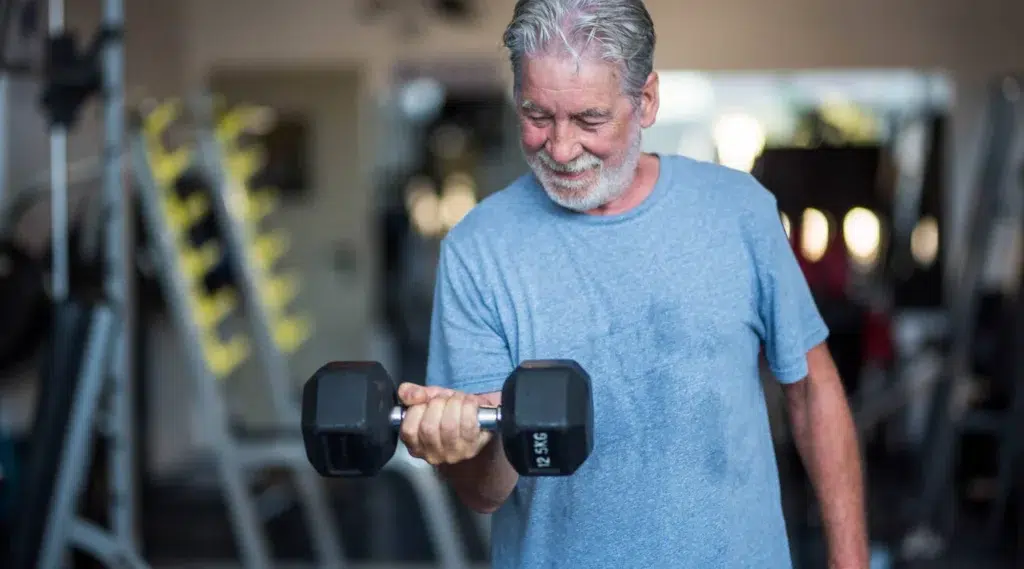
Why Specialized Personal Training Matters for Seniors in Singapore
Singapore is on a super-ageing trajectory. By 2030, roughly one in four residents will be aged 65 or older.
Ageing brings predictable physical changes. Muscle mass declines, lower-body power drops faster than strength, joints stiffen, recovery slows, and balance becomes less reliable. Left unaddressed, these changes erode independence one daily task at a time.
The crucial insight is that much of this decline is modifiable. A large share of what we call “getting old” is driven by inactivity, low strength, poor metabolic health, and lost movement confidence — all of which respond to training.
Here is where the gap appears. Most commercial gym trainers are trained to coach healthy, younger adults. Their standard programme assumes no joint history and fast recovery. Applied to a 65-year-old with osteoarthritis and a long sedentary stretch, that same programme frequently causes pain, injury, and abandonment of exercise for years.
A specialised senior coach works differently. They screen before they load, program around medical history, and progress conservatively. The difference is not intensity — it is precision.
The Markers That Actually Predict How Well You Age
A good programme for seniors targets the physical qualities most strongly linked to healthspan and independence:
- Cardiorespiratory fitness (VO2 max): one of the strongest predictors of long-term health outcomes.
- Muscle mass: a metabolic organ central to glucose control and insulin sensitivity.
- Lower-body power: the ability to produce force quickly, essential for catching a stumble.
- Grip strength: a simple marker of global physical reserve.
- Movement quality and inflammation: the foundation that lets the body tolerate training at all.
The 4-Pillar Healthspan & Fitness Framework for Older Adults
The most effective programmes for older adults are not random workouts. They are structured around four measurable pillars that together determine function, resilience, and independence.
Pillar 1: Muscle Mass & Body Composition
Muscle is not just for strength. It is a major metabolic organ and a primary site for glucose disposal — skeletal muscle is responsible for roughly 80% of post-meal glucose uptake.
Age-related muscle loss, known as sarcopenia, drives frailty, disability, and loss of independence. Progressive resistance training is the most effective known countermeasure.
In practice, this pillar focuses on preserving lean tissue, improving body composition, and supporting metabolic resilience through consistent strength work and adequate protein.
Pillar 2: Balance, Stability & Fall Prevention
Falls are one of the most serious threats to independence in later life. They rarely result from a single cause — they emerge from asymmetries, slow reactions, and poor joint integrity compounding over time.
Structured screening catches these risks before they cause injury. Common tools include:
- Y-Balance testing: identifies left-right asymmetries that predict falls and injury.
- Single-leg and tandem stance drills: train the stabilising muscles that keep you upright.
- Agility and coordination work: rehearses the quick adjustments that prevent a stumble from becoming a fall.
- Joint integrity exercises: strengthen the ankles, knees, and hips that absorb and redirect force.
Pillar 3: Cardiorespiratory Capacity & VO2 Max
Cardiorespiratory fitness reflects how effectively your body uses oxygen during exertion. It is closely tied to heart health, stamina, and daily energy.
For adults over 50, improving aerobic fitness through walking, cycling, rowing, or guided intervals is one of the highest-return changes available. Even modest improvements meaningfully reduce cardiovascular risk.
Training in this pillar is low-impact by design. The goal is a stronger heart and better endurance, not joint stress.
Pillar 4: Lower-Body Power & Strength Training
After 50, power matters as much as strength — and power declines faster with age.
Lower-body power is the ability to produce force quickly. It is what lets you catch yourself during a stumble, climb steps, rise from a chair, and react to a sudden loss of balance. Research indicates lower-extremity power is more predictive of physical performance than strength or aerobic capacity alone.
This pillar uses progressive resistance training to build strength, support bone density, and restore functional mobility. Bone responds to mechanical loading over time — it requires load, rate, and repetition — so appropriate loading is protective, not risky.
For adults who need a lower-impact entry point, whole body vibration can supplement resistance work. It has been associated with improvements in balance, muscle power, functional lower-body strength, and cardiorespiratory fitness in older adults.
Key Benefits of Hiring a Dedicated Senior Personal Trainer
A specialised coach delivers far more than workout supervision. They deliver a system built around your body and your history.
- Customized screening: grip strength, joint mobility, movement assessment, and injury history are measured before any load is added.
- Safe progression around injury and disease: programmes are adapted for osteoarthritis, past injuries, and chronic conditions rather than forcing a generic template.
- Data-backed tracking: re-assessment every 12 to 16 weeks shows objective progress in strength, balance, and body composition.
- Technique correction in real time: bad form is caught in the moment, protecting joints and building efficient movement patterns.
- Confidence building: supervised, gradual progress restores the movement confidence that inactivity erodes.
- Lifestyle support: guidance on protein intake, sleep, stress, and recovery that reinforces training results.
For adults over 50, these elements make training safer, more targeted, and far easier to sustain. That is the difference between an exercise attempt and a lasting improvement in quality of life.
What to Avoid When Starting Fitness After 50 or 60
Most people over 50 do not fail because they are incapable. They fail because they follow the wrong method.
- Copying workouts designed for younger people. A programme built for a 25-year-old ignores joint history and recovery differences.
- Jumping into high-intensity classes too quickly. Sudden intensity on untrained tissues is the fastest route to injury.
- Ignoring pain signals. Discomfort is information. Training through it usually prolongs the setback.
- Chasing scale weight instead of body composition. Function and lean mass matter more than a single number.
- Skipping balance and power work. Strength alone does not prevent falls or restore daily capability.
- Rushing intensity without proper biomechanics. Load added before technique is mastered loads the wrong structures.
- Training without progression or tracking. Random workouts produce random results and no measurable improvement.
Guided coaching removes each of these risks. It replaces guesswork with assessment, and random effort with a progression you can actually see.
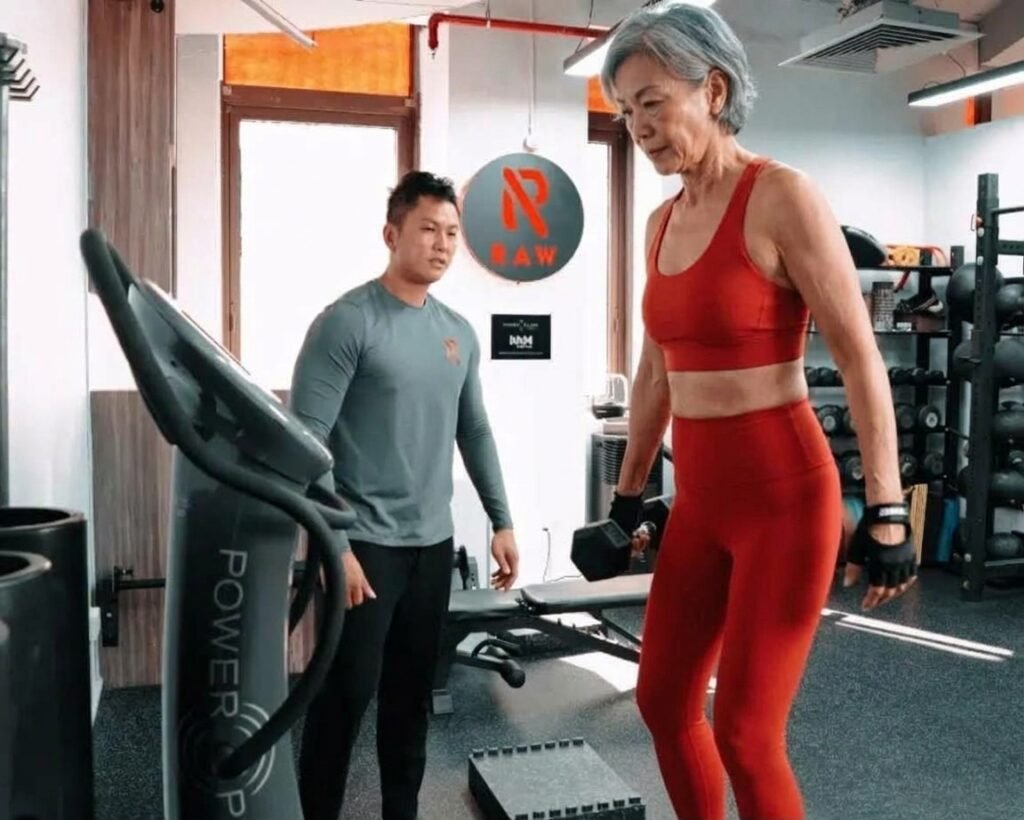
How to Choose the Right Personal Trainer for Elderly in Singapore
Choosing a trainer for an older adult is a decision about safety and expertise, not just convenience. Use this checklist when evaluating options.
- Medical literacy: the trainer should understand osteoarthritis, hypertension, joint replacement, and other common conditions, and know when to defer to a doctor.
- Fall-risk screening: assessment should include balance and asymmetry testing, not just a strength test.
- Personalized load management: loading should be calibrated to current capacity and adjusted session by session.
- Rehab-aware programming: experience adapting exercises around past injuries is essential, not optional.
- Measurable tracking: ask how progress is measured and how often it is reviewed.
- Private, unhurried setting: a quiet, appointment-based studio removes the crowds, noise, and pressure of a commercial gym floor.
- Convenience and consistency: whether your training is at a central studio or at home, location drives adherence — and adherence drives results.
- Realistic promises: be cautious of anyone selling rapid transformation over sustainable, measured progress.
Families should feel welcome to join the initial assessment. Understanding the baseline makes it easier to support the senior’s progress at home.
Frequently Asked Questions
Is strength training safe for seniors with joint pain?
Yes, when it is properly programmed. Adaptive resistance training is one of the better long-term options for arthritic joints, and the inflammation literature points in the same direction.
The key is to work around pain, not through it. A qualified trainer identifies which movement patterns are comfortable and which need a different entry path, then builds from there.
How often should elderly adults train with a personal coach?
Most older adults do well with two to three structured sessions per week, spaced to allow recovery. Strength work is typically the priority, supported by mobility, balance, and cardiovascular conditioning.
Frequency should be adjusted to your recovery capacity, health status, and goals. Consistency across months and years matters far more than intensity in any single week.
What is the difference between general PT and senior personal training in Singapore?
General personal training is usually designed for healthy, younger adults. Senior personal training is a separate discipline built around the physiology of ageing.
It adds medical screening, fall-risk assessment, joint-friendly loading, and slower, more carefully managed progression. The goal shifts from performance to independence, function, and long-term healthspan.
Do I need to be fit before starting?
No. A proper assessment calibrates the programme to where your body is today, not where you think it should be. Complete beginners in their 60s and 70s start safely every day.
Can you still build muscle after 50 or 60?
Yes. Muscle remains highly trainable well beyond 50. With consistent resistance training, appropriate progression, and adequate protein, older adults can build and maintain muscle that supports daily function and metabolic health.
Train to Stay Independent — The RAW Active Approach
At RAW Active Personal Training, the focus is not simply exercising more. It is training to stay out of pain, improve functional strength, and build a body that serves you for decades.
Our model includes body measurement, movement assessment, tailored programme design, lifestyle support, and tracked progression. Every plan respects previous injuries, joint pain, and medical conditions instead of forcing you into a generic template.
For adults in their 50s, 60s, and beyond, that structure delivers what matters most: better balance, restored strength, improved body composition, and the independence to keep doing what you love.
Fitness over 50 is not about training like you are 25. It is about building a body that is stronger, steadier, and more resilient for the life you want to live now.
Book a consultation with RAW Active and start with a personalised programme built around your strength, mobility, and long-term health goals.