
Finding the right private gym in Singapore is harder than it looks. You can spend weeks visiting facilities, only to discover that the trainer assigned to you has a generic program copied from a template, the equipment is outdated, and your sessions keep getting bumped because of overcrowding. For busy professionals managing demanding careers alongside real fitness goals, whether that is fat loss, injury rehabilitation, or building functional strength, that kind of wasted time is genuinely costly. This guide gives you a clear, step-by-step system for identifying, evaluating, and committing to a premium private gym that actually delivers measurable results.
Table of Contents
- Understand your fitness needs and goals
- Essential criteria for evaluating private gym facilities
- Step-by-step process: How to shortlist and assess private gyms
- Verifying quality and maximizing results
- Why value trumps price when selecting a private gym
- Next steps: Unlock your premium gym experience in Singapore
- Frequently asked questions
Key Takeaways
| Point | Details |
|---|---|
| Clarify your fitness goals | Define exactly what you want from a private gym to focus your search and boost success. |
| Insist on top credentials | Choose facilities with certified trainers and transparent, value-driven programs for best results. |
| Test before you commit | Use trial sessions and detailed questions to ensure the gym matches your expectations and lifestyle. |
| Monitor progress | Expect structured tracking of results; make adjustments or switch facilities if promises aren’t met. |
| Invest in value, not just cost | Premium gyms yield better outcomes for busy professionals who want personalized, lasting fitness. |
Understand your fitness needs and goals
With the stage set for making a smart gym decision, the first step is clarifying exactly what success looks like for you.
Most professionals walk into a gym search thinking about location and price. That is understandable, but it puts the cart before the horse. Before you compare facilities, you need an honest picture of what you are trying to achieve, how often you can realistically train, and whether you have any physical considerations that should shape your program.
Start by identifying your primary fitness goal. These typically fall into one of several categories:
- Fat loss and body composition improvement
- Muscle building (hypertrophy) and strength development
- Injury rehabilitation and pain-free movement
- Athletic conditioning and performance
- General health, stress relief, and energy management
- Pre or postnatal fitness support
Each goal demands a different training methodology, different equipment, and a different kind of trainer expertise. A professional recovering from a lower back injury needs a coach with corrective exercise credentials, not just someone who can run a high-intensity circuit. A senior executive managing chronic stress may benefit from a structured strength program combined with recovery modalities. Being specific here is not overthinking. It is the foundation of every good decision that follows.
Next, assess your schedule honestly. How many sessions per week can you commit to without sacrificing work or family obligations? Which time slots are genuinely available, not just theoretically possible? A gym that only offers early morning slots when your calendar is packed until 9 AM is not a realistic option, regardless of how impressive the facility looks.
Also consider unique needs. Do you require privacy for personal or professional reasons? Are you managing a recurring injury or a postoperative condition? Do you need a trainer who can integrate nutrition guidance into your program? These factors directly shape which gyms belong on your shortlist. As highlighted in guidance on finding your ideal personal trainer, trainer experience should match client goals, and personalized programs must be tailored to both your schedule and specific objectives.
“The clearest fitness goals produce the sharpest training programs. Vague intentions lead to vague results.”
Pro Tip: Write down your top three fitness goals and your three non-negotiable scheduling constraints before you contact a single gym. This simple exercise will eliminate at least half of your options immediately and save you hours of unnecessary visits.
Clarity at this stage is not just helpful. It is essential. Every other evaluation criterion, from trainer credentials to equipment quality, only makes sense in the context of what you are actually trying to accomplish.
Essential criteria for evaluating private gym facilities
Once you are clear about your goals, it is time to judge gyms by the standards that matter most.
Not all private gyms are created equal. In Singapore, the market ranges from legitimate premium studios with award-winning coaches to rebranded commercial gyms charging premium prices for a mediocre experience. Knowing what to look for protects you from making an expensive mistake.
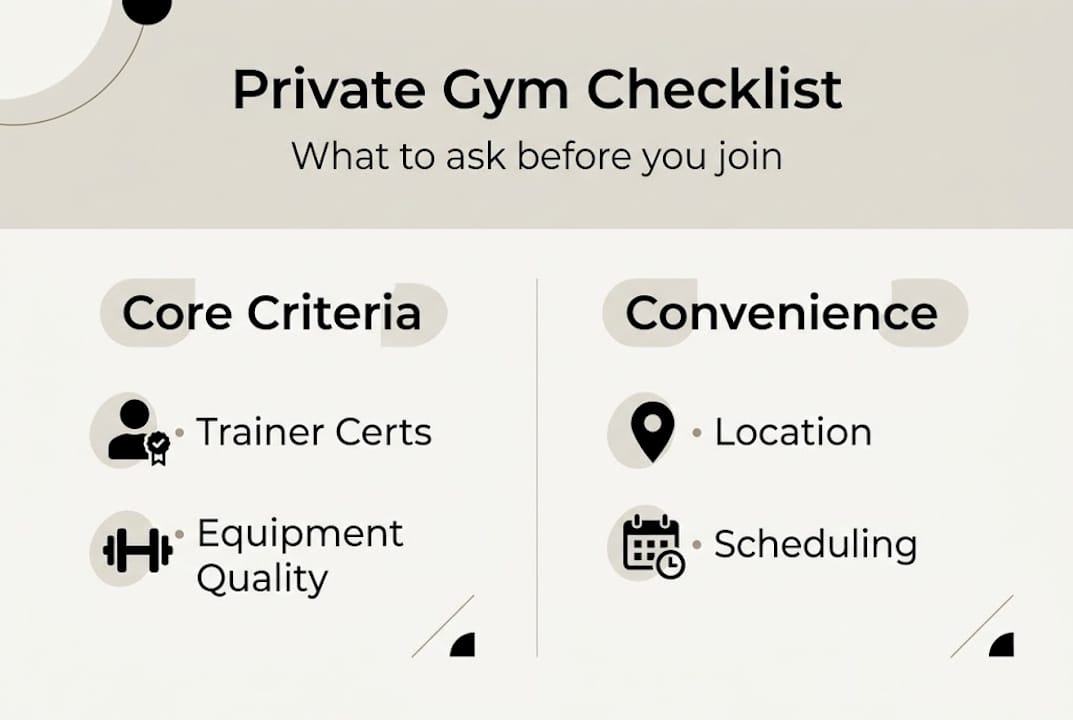
Trainer credentials and certifications are your first filter. Look for coaches certified by recognized bodies. Reputable certifications from organizations like ACE, NASM, NSCA, or SportSG signal that a trainer has met professional standards. Better still, look for trainers who hold degrees in sports science or carry specialized certifications such as Applied Functional Science (CAFS). At RAW Active, for example, our team regularly holds these higher-level credentials, which directly influences the quality of programming you receive.
Location and scheduling flexibility matter enormously for professionals. A gym near your office or home reduces the friction that causes people to skip sessions. Equally important is the rescheduling policy. Life happens. Meetings run late. Travel comes up. A gym that penalizes you for rescheduling with short notice is not built for how professionals actually live.

Equipment quality and variety separate genuine performance studios from aesthetically polished but functionally limited spaces. Look for functional training tools, free weights with proper weight ranges, and recovery technology. Specialized equipment like Keiser Functional Trainers, Eleiko weightlifting sets, and Power Plate units represent a meaningful investment in your outcomes.
Transparent pricing and trial options are non-negotiable. Any reputable gym should offer a trial session or initial consultation before asking you to commit. Watch for hidden fees, aggressive upselling, or package structures that lock you in without flexibility.
Here is a quick comparison of what separates premium private gyms from standard commercial options:
| Criteria | Premium private gym | Standard commercial gym |
|---|---|---|
| Trainer credentials | Degree-level, specialized certs | Basic certification only |
| Session availability | Appointment-only, flexible | First come, first served |
| Equipment | Specialized, world-class | Standard, shared |
| Program personalization | Fully customized | Generic templates |
| Privacy | Controlled capacity | Open, crowded |
| Progress tracking | Structured, objective | Informal or absent |
Red flags to watch for include:
- Pushy sales tactics during your first visit
- No individualized assessment before programming begins
- Inability to explain the rationale behind your training plan
- No system for tracking and reporting your progress
The difference between private gyms and commercial gyms is not just about aesthetics or exclusivity. It is about whether the environment and the team are genuinely structured to produce results for you specifically.
Pro Tip: Ask the gym directly: “How do you track client progress, and how often do you review and adjust the program?” A confident, specific answer signals a results-oriented culture. Vague or dismissive responses are a warning sign.
Step-by-step process: How to shortlist and assess private gyms
Armed with your criteria, here is how to efficiently put them into practice.
The gym selection process does not need to be overwhelming. Breaking it into clear steps helps you move quickly and confidently without second-guessing yourself at every turn.
Step 1: Research your options. Start with word-of-mouth recommendations from colleagues or friends who share similar fitness goals. Online reviews on Google and fitness forums provide useful signals, but look for patterns rather than individual opinions. Professional directories and industry award listings, such as gyms recognized for specialized excellence in Asia, are also strong indicators of quality.
Step 2: Build a shortlist of three to five gyms. Filter by location first. A gym that adds 40 minutes of commute to your session is a gym you will eventually stop attending. Then filter by credentials, facility type, and whether they offer the specific services you identified in step one.
Step 3: Make initial contact and ask the right questions. Before booking a visit, call or email each gym with a short list of qualifying questions. Ask about trainer qualifications, session availability during your preferred time slots, rescheduling policies, and whether they offer a trial session.
Step 4: Book and evaluate trial sessions. This is where the real assessment happens. A trial session lets you test the training style, evaluate facility comfort, and assess service transparency firsthand. Pay attention to how the trainer listens to you, how they explain their approach, and whether the session feels genuinely personalized or generic.
Step 5: Ask detailed follow-up questions. After the trial, ask specifically about program customization, how they handle nutrition guidance or rehabilitation needs, and what happens if your goals evolve over time. A good gym has clear answers to all of these.
Here is a simple evaluation framework to use during your trial visits:
| Evaluation area | Questions to ask | Green flag | Red flag |
|---|---|---|---|
| Trainer expertise | Qualifications and experience | Degree, specialized cert | Basic cert only |
| Personalization | How is my program built? | Full assessment first | Generic template |
| Scheduling | Flexibility and rescheduling | Easy, no penalty | Rigid, penalizing |
| Progress tracking | How are results measured? | Objective markers | Informal or none |
| Nutrition support | Is guidance available? | Integrated or referred | Not offered |
The personal training guide for Singapore outlines how a structured assessment process leads to far better long-term outcomes than simply picking the most convenient or visually appealing option.
Pro Tip: Bring a short written summary of your goals and constraints to your trial session. Handing it to the trainer at the start tells you immediately how they respond to client-specific information. A great trainer will engage with it directly. A mediocre one will set it aside.
Verifying quality and maximizing results
After your selection, quality does not stop. Here is how to ensure your gym delivers on its promises.
Choosing the right gym is only the beginning. The real work is making sure the relationship continues to serve your evolving needs and that you are seeing measurable progress over time.
Understand what good progress tracking looks like. A quality private gym should use objective markers to assess your development. These include body composition analysis (not just weight), strength benchmarks, movement quality assessments, and energy or recovery indicators. If your gym only checks in informally or relies on how you “feel,” that is not sufficient for a results-focused professional.
Set realistic milestones for the first three months. For most busy adults training two to three sessions per week, you can expect meaningful changes in strength, movement quality, and body composition within 8 to 12 weeks. Fat loss of one to two kilograms per month is realistic and sustainable. Significant strength gains are typically visible within six to eight weeks of consistent, well-programmed training.
What you should realistically expect:
- Weeks 1 to 4: Improved movement patterns, better energy levels, initial strength adaptation
- Weeks 5 to 8: Measurable strength gains, early body composition shifts
- Weeks 9 to 12: Visible changes in physique, improved athletic output, stronger recovery
Know how to request program adjustments. Your life changes. Your goals may shift. A good coach welcomes these conversations and adapts your program accordingly. If you are traveling frequently, recovering from a minor injury, or simply plateauing, your trainer should proactively address this. If they do not, you should initiate the conversation without hesitation.
“Your training program is a living document. It should evolve as you do, not stay fixed because it was convenient to write once.”
Warning signs that it may be time to reconsider your gym choice include:
- No formal progress review after 8 to 12 weeks
- Trainer consistently running the same session structure without variation
- Your stated goals are no longer reflected in your programming
- Difficulty communicating concerns or requesting adjustments
The personal training Singapore guide reinforces that accountability and structured progress reviews are what separate transformative training experiences from those that simply maintain the status quo.
Why value trumps price when selecting a private gym
While practical steps matter, the underlying philosophy of investment also determines your outcomes.
We see this pattern repeatedly. A professional chooses a cheaper gym to test the waters, invests three months of time and energy, sees minimal results, and then comes to us frustrated and behind schedule. The irony is that the cheaper option almost always costs more in the long run, because time is the one resource you cannot recover.
Premium private gyms deliver better long-term outcomes through expert coaching, privacy, and personalized programming. For Singapore professionals optimizing limited time, this is not a luxury. It is a strategic decision. When you train in a private, appointment-only environment with a coach who holds a degree in sports science and has built a program specifically for your body and schedule, every session produces a return. There is no wasted time waiting for equipment, no distraction from a crowded floor, and no guesswork in your programming.
Clients who prioritize value over price consistently see faster results, better adherence, and a stronger sense of ownership over their fitness journey. The investment is real, but so is the outcome. Explore how achieving fitness goals with expert guidance changes the entire equation for professionals who take their health seriously.
Next steps: Unlock your premium gym experience in Singapore
Ready to make a confident choice and see real fitness improvements?
If you have followed this guide, you already have a clearer picture of what you need from a private gym and what questions to ask when you visit one. The next step is taking action before another week passes without meaningful progress toward your goals.
At RAW Active, we built our studio specifically for professionals like you. Every session is appointment-only, every program is built from scratch around your goals, and every trainer on our team holds credentials that go well beyond the industry standard. Whether your priority is fat loss, strength, rehabilitation, or simply reclaiming your energy, we are here to make it happen efficiently and sustainably. Explore how personal training as an essential service and the integration of personal training and nutrition can accelerate your results. Reach out today to book your initial consultation or trial session.
Frequently asked questions
How many private gym sessions per week are recommended for busy professionals?
Most experts advise 2 to 3 sessions per week as an effective and sustainable starting point, giving your body adequate recovery time while building consistent momentum.
What are the must-have trainer certifications in Singapore private gyms?
Look for trainers certified by ACE, NASM, NSCA, or SportSG, as these organizations set credible professional standards. Degree-level qualifications in sports science are an even stronger indicator of expertise.
How much privacy can I expect in a premium private gym?
Premium gyms typically limit session capacity and operate on an appointment-only basis, ensuring you train in a focused, distraction-free environment without sharing space with strangers.
What red flags should I watch for when touring a private gym?
Avoid gyms with pushy sales tactics, no individualized focus, or no progress tracking, as these signal a culture that prioritizes revenue over your actual results.
Recommended
- Private Gyms vs Commercial Gyms in Singapore: Which is Right for You? – Raw Active
- Permanently Closed Gyms in Singapore: Complete 2016-2025 List & Why You Need to Choose Wisely – Raw Active
- The Ultimate Guide to Personal Training in Singapore: RAW Active vs. Top Competitors (2025) – Raw Active
- The Ultimate Guide to Finding Your Ideal Personal Trainer in Singapore’s Competitive Fitness Landscape – Raw Active