
TL;DR: There is no single best personal training certification in Singapore for everyone. The smartest route is to choose a recognised certification, secure a valid Standard First Aid with CPR + AED certificate, aim for NREP readiness, and build real coaching hours in a setting that matches the clients you want to serve.
- What Is a Personal Training Certification?
- Why Does Certification Matter in Singapore?
- What Is the Best Personal Training Certification in Singapore?
- How to Become a Fitness Instructor in Singapore: The 5-Step Path
- Online vs Onsite Certification
- What Else Helps You Get Hired?
- How Can Clients Use Certification as a Signal?
- FAQ

What Is a Personal Training Certification?
A personal training certification is a professional qualification that shows a coach has studied core training topics such as anatomy, exercise programming, screening, and safety. It gives a basic level of industry credibility, but it does not replace real coaching hours, communication skill, or practical judgment on the gym floor.
That distinction matters for both trainers and clients. A certificate shows structured education, while good coaching shows up in exercise selection, cueing, progress tracking, and the ability to adapt training to the person in front of you.
Why Is Certification Different From Coaching Skill?
Certification proves formal study, while coaching skill proves applied competence. A newly certified trainer may understand theory, but real coaching quality is built through repetition, supervised practice, and problem-solving with actual clients who have different goals, limitations, motivation levels, and recovery needs.
This is why two trainers with the same credential can feel very different in person. One may teach clearly and adapt well, while another may still be learning how to turn knowledge into useful coaching.
Why Does Certification Matter in Singapore?
Certification matters in Singapore because gyms, studios, and clients use it as a first quality filter. There is no single government licence that automatically makes someone a coach, so recognised certifications, valid first aid readiness, and increasingly an NREP listing are the signals that usually matter most in hiring and trust-building.
That makes certification a practical entry tool, not just a badge. It helps employers reduce risk and gives new trainers a clearer path into gyms, studios, and coaching roles.
Why Do First Aid, CPR, and AED Matter So Much?
First Aid with CPR + AED matters because it is a real-world safety requirement, not a nice extra. In Singapore, it is commonly expected for gym-floor work and is a hard requirement for NREP registration, which means a trainer can study hard and still get blocked at interview stage without it.
That is why it makes sense to get this done early. It is one of the few items in the process that no amount of theory can replace.
What Is the Best Personal Training Certification in Singapore?
There is no single best personal training certification in Singapore for every coach. The best choice depends on where you want to work, what type of clients you want to coach, how you learn best, and how much time and money you can realistically invest at the start.
A better question is usually this: which certification gives you the strongest entry into the gyms or coaching niche you actually want. That keeps the decision practical instead of emotional.
Which Certification Names Carry the Most Weight?
The four certification names most commonly presented as strong options in Singapore are NASM, ACE, NSCA, and NCSF. These are widely recognised starting points because they are established, commonly discussed by employers, and generally treated as more credible than weaker shortcut certifications.
That does not mean they are identical. Each one tends to suit a different kind of learner or career direction.
- NASM-CPT: Often suits self-starters who want a credible lower-cost entry path.
- ACE-CPT: Often suits beginners who want structure and classroom-style support.
- NSCA-CPT: Often suits coaches interested in performance, strength, or rehab-adjacent work.
- NCSF-CPT: Often suits people who want to start earning sooner and deepen later.
- Local diploma routes: Often suit career changers targeting larger clubs or full-time roles.
Why Is “Best” the Wrong Way to Think About It?
The word best is often misleading because a certification that fits one coach perfectly may be the wrong fit for another. A self-paced online learner, a future performance coach, and a career changer aiming at big-box gyms may all need different starting routes to succeed.
That is why clarity beats hype. Match the certification to the career path, not the marketing line.
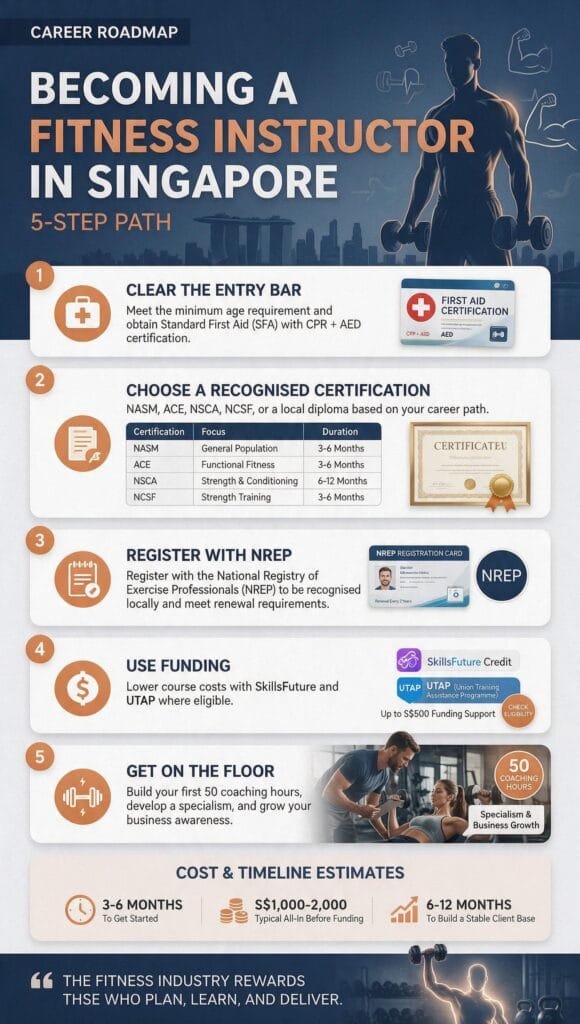
How to Become a Fitness Instructor in Singapore: The 5-Step Path
There is no single government licence to coach in Singapore. What gyms, studios, and clients usually check is a recognised certification, a valid Standard First Aid with CPR + AED certificate, and increasingly an NREP listing. Plan for roughly three to six months and about S$1,000–2,000 all-in, or less with funding support.
Most people asking how to become a fitness instructor are really asking three things: what do I need, what does it cost, and who will hire me. The path below answers those questions in the order that matters most.
Step 1: How to Clear the Entry Bar Before You Spend a Dollar
The first step is to clear the true entry bar before spending heavily on courses. In practice, the two non-negotiables are age eligibility and a valid Standard First Aid certificate with CPR + AED, because this safety requirement affects both NREP entry and real gym-floor employability.
Most certifying bodies set 18 as the baseline age, although some, such as ACE, may accept candidates from 16. If you do not already hold first aid with CPR + AED, get that first. Some providers bundle or subsidise it, and NSCA Singapore is one example of a provider that runs reduced-rate sessions for course candidates.
- Age baseline: Usually 18, though some certification routes may accept younger candidates.
- Safety baseline: Valid Standard First Aid with CPR + AED is the key early requirement.
- Practical advice: Get first aid done first so it does not delay interviews later.
Step 2: How to Get Certified for the Gyms You Actually Want
The second step is to choose a certification route based on where you want to work, not on which brochure sounds most impressive. In Singapore, NASM, ACE, NSCA, and NCSF are the four names most commonly treated as credible starting points.
Your choice should reflect your likely work environment. If you are undecided, the simple way to think about the market is this:
- NASM-CPT: Self-paced online plus exam; often suits self-starters who want the cheapest credible entry.
- ACE-CPT: Blended, often with a local provider; often suits beginners who want more structure and a Singapore classroom setting.
- NSCA-CPT: Around 40 hours over 3 weekends plus a 155-question, 3-hour exam; often suits people targeting performance, strength, or rehab-adjacent work.
- NCSF-CPT: Can be as short as a 2-day intensive; often suits people who want to start earning quickly and add depth later.
- Local diploma routes: Longer and more expensive; often suit career changers aiming for full-time employment with larger clubs.
The short version is simple: a weekend-style certificate may get you in the door, while a diploma-style route may give you broader options later.
Step 3: Why You Should Register With NREP
The third step is to plan for NREP registration, because it is increasingly treated as Singapore’s local quality mark for exercise professionals. It is not legally required to coach, but more employers now ask for it, so choosing a course that supports NREP entry can save money and duplication later.
The source requirements include relevant fitness certification, acknowledgement of the exercise professional code of ethics, valid Standard First Aid with CPR + AED, and Safe Sport certification. From 1 June 2026, a Basic Exercise Science certification or equivalent is also required, with a current route offered through Republic Polytechnic.
Registration lasts three years, and renewal requires 30 continuing education hours. That means the smart move is to think beyond the first exam and choose a certification that fits both entry and renewal planning.
Step 4: How to Use SkillsFuture and UTAP to Lower the Cost
The fourth step is to use SkillsFuture and UTAP properly, because funding can change the decision completely. Singapore-based candidates often save the most at this stage, and some course pathways become dramatically more affordable once available support is applied to otherwise expensive certification fees.
SkillsFuture Credit is commonly promoted by providers of NSCA, ACE, and NCSF courses, with some routes advertising up to S$1,000 of support for eligible Singaporeans aged 25 and above. UTAP, for eligible NTUC members, may cover 50% of unfunded fees, capped at S$250 per year for members under 40 and S$500 per year for members 40 and above, subject to attendance.
When stacked properly, the numbers change a lot. One published example shows an NCSF course landing around S$338 after funding, while an NSCA-CPT route listed at S$1,650 public may end up roughly in the S$900–1,150 range after funding effects are applied.
Step 5: How to Get on a Floor and Earn Your First 50 Hours
The fifth step is to get real coaching hours, because certification is an entry ticket, not a job. In Singapore, new instructors often get hired faster when they bring a useful specialism, supervised hours on the floor, and enough business awareness to keep clients, manage schedules, and avoid early burnout.
The first 50 hours matter because they prove you can stand next to a client and coach. Offer to assist classes, shadow a senior coach, or take a few low-rate informal clients to build real practice. The coaches who establish stable client bases usually do not only study better. They coach more, learn faster, and understand retention early.
- Build a specialism: Rehab, pre and post-natal, older adults, HYROX, and strength sport are current demand areas.
- Get supervised hours: Employers hire people who have coached, not just people who have passed exams.
- Learn the business side: Retention, pricing, and scheduling often decide whether a trainer lasts.
- Set realistic expectations: A stable client base often takes six to twelve months from first course payment.
Online vs Onsite Certification
Online and onsite certification both work, but they suit different learners. Online study often offers better flexibility and lower friction for working adults, while onsite learning often gives more structure, live discussion, and direct feedback, which may help newer learners absorb material more confidently and consistently.
The better format is the one that helps you finish well and coach safely after the exam. Convenience matters, but learning quality matters more.
What Are the Main Benefits of Online Certification?
Online certification often suits self-directed learners who need flexible scheduling, reduced travel time, and lower upfront friction. It may also be the most practical option for career changers or busy adults who want to study around work while still getting a recognised starting credential.
The risk is not the format itself. The risk is assuming flexibility will automatically create discipline.
What Are the Main Benefits of Onsite Certification?
Onsite certification often benefits people who learn better through live explanation, immediate questions, and structured accountability. It may also feel more practical for beginners who want clearer momentum, movement demonstration, and a classroom setting that reduces the chance of drifting or delaying exam preparation.
For some learners, this makes a major difference. Structure often improves follow-through more than motivation alone.
What Else Helps You Get Hired?
Beyond the certificate itself, the trainers who often get hired fastest are the ones who bring a clear specialism, real coaching experience, and enough business sense to retain clients. Gyms do not only hire paper qualifications. They hire people who can coach, communicate, and contribute to a working business.
This is why early career strategy matters. A strong certificate plus weak floor presence is rarely enough for long-term success.
Why Does Specialisation Matter for New Trainers?
Specialisation matters because generalist trainers compete with nearly everyone. A coach who can clearly help older adults, strength athletes, rehab-aware clients, or HYROX participants becomes easier to recommend, easier to position, and often easier to remember in a crowded local market.
You do not need to narrow too early without reason. You do need a direction that makes your value clearer than “I can train anyone.”
Why Do Supervised Coaching Hours Matter So Much?
Supervised coaching hours matter because they develop judgment, cueing, presence, and problem-solving in ways theory alone cannot. Employers often trust practical experience because it shows you have already worked through real human variation, awkward sessions, small mistakes, and on-the-floor decision-making under pressure.
This is where coaches stop sounding like course notes and start sounding like professionals. Repetition builds clarity.
Why Does Business Awareness Matter for Trainers?
Business awareness matters because many employed trainers in Singapore are paid per session rather than through a fixed salary model. Coaches who understand retention, pricing, scheduling, and relationship-building often last longer because they can keep clients engaged instead of relying only on new leads.
This is also why some strong coaches still struggle financially. Coaching skill without commercial awareness can be hard to sustain.
How Can Clients Use Certification as a Signal?
For clients, certification is a useful trust signal, but it should not be the only filter. A recognised credential suggests baseline professionalism, yet the better coaching question is still whether the trainer can assess clearly, explain well, adapt safely, and match the plan to your real goals and recovery needs.
That means certification should open the conversation, not end it. Clients still need to judge fit, communication, and practical experience.
What Else Should Clients Check Besides the Certificate?
Clients should also check experience, communication style, assessment quality, and goal fit. A well-certified trainer may still be the wrong coach if they cannot explain clearly, listen properly, or adjust around injury history, confidence level, or the type of result the client actually wants.
If you want a broader reader-facing guide, how personal trainers can help you is a natural next step.
Why Does Training Setting Matter to Both Trainers and Clients?
Training setting matters because coaching quality is affected by environment, noise, equipment access, and the kind of support the gym model allows. Some people thrive in larger commercial clubs, while others improve faster in quieter coaching-led spaces with more personal attention and fewer distractions.
That is true for both career planning and client experience. If this matters to you, private gym vs commercial gym helps frame the trade-offs more clearly.
FAQ
This FAQ on personal training certification in Singapore answers the practical questions most people ask before they spend money or commit to the industry. The short answer is simple: choose a recognised route, cover your safety requirements, use funding if available, and then build real coaching hours fast.
Do you need a government licence to be a trainer in Singapore?
There is no single government licence that automatically qualifies someone to coach in Singapore. In practice, employers and clients usually look for a recognised certification, a valid Standard First Aid with CPR + AED certificate, and increasingly an NREP listing or NREP-ready pathway.
How long does it usually take to become job-ready?
Most people can become entry-level job-ready in roughly three to six months if they move through certification, first aid, and job preparation efficiently. Building a stable client base usually takes longer, and six to twelve months is often a more realistic timeline for developing steady coaching income.
How much does it usually cost to start?
A realistic starting budget is often around S$1,000 to S$2,000 all-in, depending on the certification route, first aid costs, and study format. The total can be reduced significantly if you qualify for SkillsFuture or UTAP, which may change the economics of the decision completely.
Is a diploma better than a certification?
A diploma is not automatically better than a certification, but it may create broader options later, especially for career changers or people targeting full-time employment with larger clubs. A certification often gets you in the door faster, while a diploma may offer longer-form education and progression.
What should aspiring trainers do right after getting certified?
Right after getting certified, aspiring trainers should secure floor hours, sharpen communication, and begin building a useful specialism. They should also learn the commercial side of coaching, including pricing, retention, and how the local market works, including topics like personal training costs in Singapore.
Final takeaway: If you want to become a fitness instructor in Singapore, stop looking for one magic certificate. Get a recognised credential, complete your first aid with CPR + AED early, plan for NREP readiness, use funding where possible, and then get on the floor fast enough to turn knowledge into real coaching skill.