
Introduction to Anti-Aging Fitness Regimens
Anti-aging fitness regimens are structured exercise programmes designed to slow the physical and cellular decline that comes with age. They are not about chasing a younger body for vanity. They are about preserving muscle, bone, joint, brain, and metabolic health so you can stay independent, energetic, and free of chronic disease for as long as possible. The science is firm on the basics: the right kind of training, repeated over months and years, slows sarcopenia, protects bone density, improves insulin sensitivity, supports telomere maintenance, and lifts mood, sleep, and cognition in parallel.
How Aging Affects Your Body
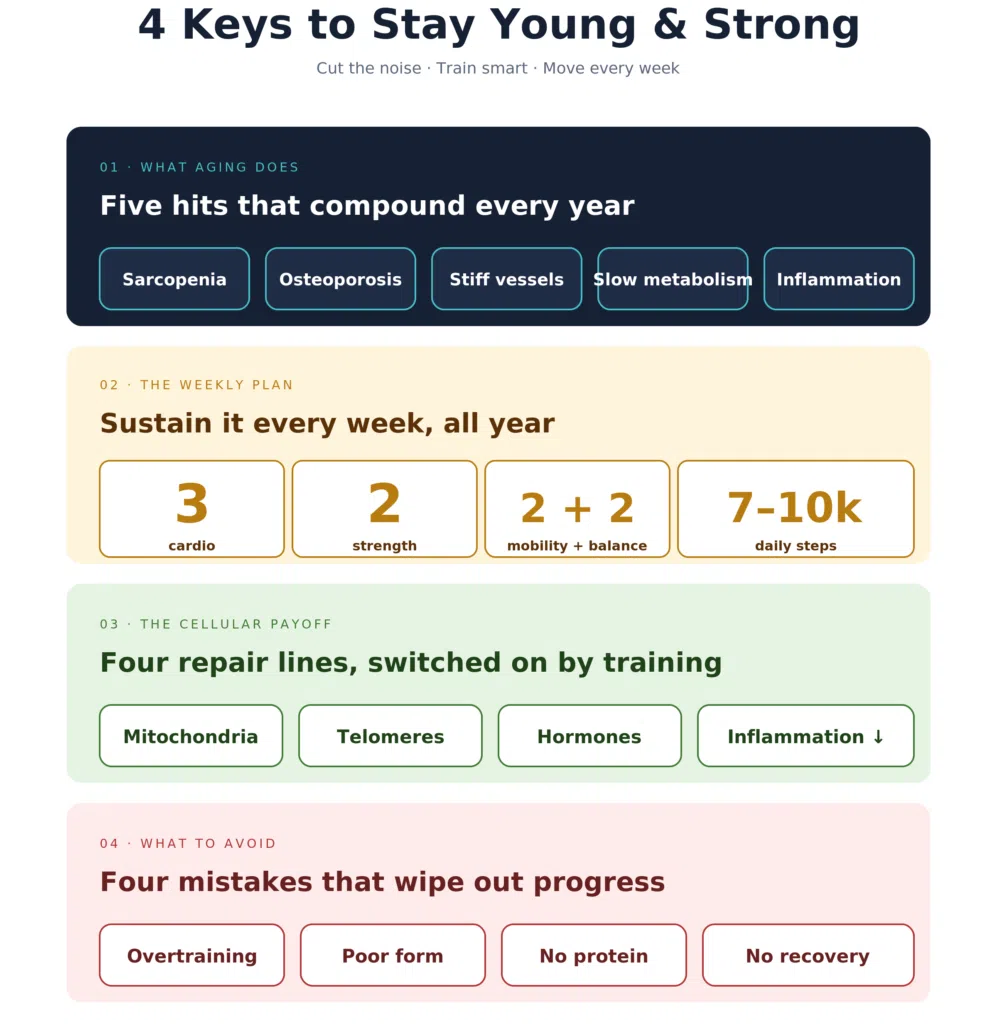
Aging affects almost every system in the body, but a few areas cause the most life‑changing problems for working adults in Singapore.
- Sarcopenia: The steady loss of muscle mass and strength that starts in the mid‑30s and accelerates after 60 if not trained against.
- Osteoporosis: Loss of bone density that raises fracture risk, especially in the hips, spine, and wrists.
- Metabolic slowdown: Insulin sensitivity drops, blood sugar regulation worsens, and the risk of type 2 diabetes climbs.
- Cardiovascular stiffening: Arteries lose elasticity, resting heart rate patterns shift, and aerobic capacity declines each decade after about age 25.
- Joint and connective tissue changes: Cartilage thins, tendons stiffen, and balance reactions slow, raising fall risk.
- Cognitive and mood shifts: Memory, processing speed, and stress regulation all benefit from regular movement when the right dose is delivered.
The Science Behind Anti-Aging Fitness
Modern exercise science shows that the right training stimulates the same cellular machinery that slows aging. Mitochondrial biogenesis rises when you do aerobic and resistance work, which means each cell can produce energy more efficiently. Telomere maintenance is supported by consistent training, sleep, and recovery. Insulin sensitivity improves inside muscle that is being used against load. Autophagy, the cell’s housekeeping process, is also stimulated by regular movement, helping clear damaged proteins before they pile up.
What a Fitness Plan Should Aim For
An anti-aging fitness plan is built on five pillars: aerobic capacity, strength, flexibility, balance, and recovery. Skipping any one of them leaves a gap that shows up within a year. The combined effect is what creates measurable resilience as the calendar advances.
What You Will Notice
- Climbing stairs without breathlessness or knee pain.
- Lifting groceries, children, or a backpack without strain.
- Waking up with stiffer joints that loosen up fast.
- Recovering from travel, work stress, or poor sleep in one or two nights instead of one or two weeks.
- Steadier mood, better sleep, and clearer thinking under pressure.
How Can Exercise Reverse Aging Effects?
Exercise cannot literally turn the calendar back, but it can move many biological markers in the right direction. Aerobic training lifts VO2 max, which is one of the strongest predictors of long‑term health. Strength training preserves lean mass and keeps resting metabolism supported. Mobility work safeguards the range of motion needed for daily life. Balance training lowers fall risk, the single biggest cause of injury‑related loss of independence for adults over 65. The right dose is around 2 to 4 hard sessions a week, supported with daily brisk movement.
Aerobic Exercise and Heart Health
Aerobic exercise is the cornerstone of an anti-aging plan. It improves mitochondrial density, lowers resting heart rate, supports blood pressure, and clears triglycerides from circulation. The minimum dose to see benefits is around 150 minutes of moderate work a week, with one or two harder sessions added if joints and recovery allow.
Best aerobic options for adults in Singapore
- Brisk walking on park connectors before sunrise or after 7pm.
- Stationary cycling during rainy afternoons.
- Swimming laps at an ActiveSG pool on weekends.
- Low‑impact cardio machines in air‑conditioned gyms.
- Outdoor jogs at easy conversational pace, capped at 40 minutes.
Strength Training and Muscle Maintenance
Strength training is the strongest anti‑sarcopenia tool we have. Two to three sessions a week, hitting all major muscle groups with progressive load, preserves lean mass, supports bone density, and stabilises blood sugar. The recommendation for active adults is to keep protein intake at around 1.4 to 1.8 grams per kilogram of body weight, spread across meals.
Strength session template
- Warm‑up with mobility and two ramp‑up sets.
- Two to three compound lifts (squat pattern, hinge pattern, push, pull, carry).
- Two to three accessory movements for hips, shoulders, and core.
- Cool‑down stretch focused on the muscles worked.
- Session length 45 to 75 minutes including warm‑up.
Flexibility and Joint Mobility
Flexibility work protects joint range, reduces stiffness, and lowers injury risk. Five to ten minutes a day, focused on hips, thoracic spine, ankles, and shoulders, is enough to maintain function. Stretching is most useful after a warm‑up or at the end of the day, never as a cold first move.
Balance Training to Prevent Falls
Balance training is the unsung hero of an aging plan. Two short sessions a week, each around 10 to 15 minutes, can drop fall risk by a measurable margin. Easy drills include single‑leg stands, heel‑to‑toe walking, controlled mini‑squats, and slow clock reaches. Add a wobble cushion or uneven surface to scale the challenge.
Designing a Personalized Anti-Aging Fitness Plan
A personalised plan is the difference between a generic article and a programme that actually delivers change. Follow the four steps below to build your own.
Step 1: Check Your Starting Point
Run a quick self‑audit before you begin. Write down your current weekly movement, your one‑rep bests on key lifts, your resting heart rate, your sleep score, and any niggles or injuries from the past year. This baseline is what future progress gets measured against.
Step 2: Set SMART Goals
Set goals that are Specific, Measurable, Achievable, Relevant, and Time‑bound. A 90‑day window is enough to see meaningful changes in body composition, lift numbers, and aerobic capacity. A 12‑month window is realistic for bone density, habit stability, and blood marker improvements.
Step 3: Build a Balanced Weekly Routine
A balanced week looks like this for most working adults.
- Three aerobic sessions (mix of easy and one harder).
- Two full‑body strength sessions.
- Two mobility sessions of 10 minutes each.
- Two short balance drills of 10 to 15 minutes.
- 7,000 to 10,000 daily steps as a baseline.
- One full rest day, with a light walk allowed.
Step 4: Track and Adjust
Tracking turns effort into evidence. Note your averages each week: steps, sleep, RPE during sessions, load lifted, and any joint feedback. After every four weeks, adjust load, volume, or exercise selection based on the data. If niggles stack up, de‑load for a week before progressing.
Common Mistakes in Anti-Aging Fitness Regimens
Even well‑intentioned plans can stall progress or create injuries. Avoid the four biggest traps.
Overtraining
More is not better when recovery cannot keep up. Overtraining shows up as sleeping poorly, losing motivation, seeing lift numbers drop, and feeling tired rather than refreshed after sessions. Dial back volume by one‑third for one week and rebuild from there.
Neglecting Rest and Recovery
Sleep is the foundation of every anti‑aging result. Aim for 7 to 9 hours nightly, with a consistent bedtime, a cool room around 18 to 20 degrees, and a 30‑minute wind‑down that removes screens. Days off are not lost days; they are the days your body rebuilds.
Poor Form and Technique
Technique protects joints and transfers load to the right muscles. Working with loads that hide sloppy form builds bad patterns that surface as injuries months later. Drop the weight by 10 to 20 percent and clean up each rep if form breaks.
Skipping Nutrition
Training without protein, hydration, and micronutrient support caps progress. Aim for 1.4 to 1.8 grams of protein per kilogram of bodyweight daily, distributed across three to four meals. Add colour and fibre at every meal to support gut and metabolic health.
What Are the Best Exercises for Aging Adults?
Cardio for Older Adults
- Brisk walking on park connectors (30 to 60 minutes).
- Swimming laps at ActiveSG pools (20 to 40 minutes).
- Stationary cycling while catching up on reading.
- Light jogs on soft surfaces, capped at 40 minutes.
- Tai chi or qi gong classes offered through community clubs.
Strength Routines That Work
- Bodyweight squats with controlled tempo.
- Romanian deadlifts using dumbbells or kettlebells (8 to 20 kg).
- Push‑ups scaled to a wall, incline, or floor.
- Single‑arm rows with a kettlebell or dumbbell.
- Farmer carries for grip, posture, and core stability.
- Glute bridges with a 3‑second pause at the top.
Flexibility and Mobility
- 90‑second hip openers after every strength session.
- Thoracic rotations on all fours.
- Ankle circles and calf stretches after walks.
- Shoulder pass‑throughs with a broomstick.
- Child’s pose and supine twist before bed.
Balance and Fall Prevention
- Single‑leg stands, building from 20 to 60 seconds.
- Heel‑to‑toe walking on a straight line.
- Mini‑squats on a soft mat.
- Slow clock reaches with one leg as a pivot.
- Wobble cushion drills two times a week.
Conclusion and Future Directions in Anti-Aging Fitness
Putting It Together
An anti-aging fitness regimen does not need to be complicated. Combine aerobic, strength, mobility, balance, and recovery in a predictable weekly rhythm. Track progress, adjust every four weeks, and stay consistent. The compounding effect is what delivers the result, not any single session.
Long-Term Impact of Consistency
Across 8 to 12 weeks, lift numbers move, body composition shifts, and aerobic capacity climbs. Across one to three years, bone density holds or improves, blood markers normalise, and the risk of falls and metabolic disease drops measurably. Across a decade, the gap between an active and a sedentary peer widens into independence, mobility, and quality of life.
Where the Science Is Going
Future directions include AI‑personalised programming, wearable‑driven daily readiness scores, deeper tracking of inflammation and recovery markers, and integrated coaching across movement, sleep, and nutrition. RAW Active Personal Training already brings many of these ideas to Singapore‑based clients.
Make It Last
The best plan is the one you stick to. Pick exercises you enjoy, schedule them like work meetings, and downscale before you skip. Consistency is the variable that wins the long game.
Your Next Step
For individual advice tailored to your body, history, and goals, book a free consultation with RAW Active Personal Training. The first session is an assessment and a plan, not a sales pitch.
Frequently Asked Questions
Is it too late to start an anti-aging fitness plan?
No. Adults at every age respond to the right dose of training. Even modest, consistent work improves strength, mobility, and aerobic capacity within weeks, and the gap between active and sedentary peers widens with each decade.
How many days a week should I train?
Most adults do well with three to five focused sessions a week: two to three strength, one to two aerobic, plus daily walks. Add two short mobility or balance drills to round out the week.
What is the best exercise for anti-aging?
There is no single best exercise. The combined effect of strength, aerobic, mobility, balance, and recovery delivers the result. Pick the version you will do consistently.
How long until I see results?
Energy, sleep, and mood often shift in two to four weeks. Lift numbers, walk pace, and body composition typically show clear change in 8 to 12 weeks. Bone density and blood markers take six to twelve months.
Do I need supplements?
A balanced plate covers most needs. Targeted supplements, like vitamin D, omega‑3, magnesium, or creatine, may help when blood tests show a gap or when diet cannot fully deliver the dose. Always check with a clinician for personal conditions.
Can I train if I have joint pain?
Yes, with adjustments. Swap high‑impact moves for low‑impact versions, scale load, and clean up technique. Sharp pain is a stop signal. Dull, recoverable soreness is normal.
How much protein do I need?
Roughly 1.4 to 1.8 grams per kilogram of body weight per day, spread across three to four meals. Active adults can lean toward the higher end. Older adults benefit from even distribution to protect lean mass.
Is sleep really that important?
Yes. Sleep is the foundation of recovery, hormone balance, memory, mood, and immune function. Aim for 7 to 9 hours with a fixed schedule, a cool dark room, and a wind‑down routine.
Why are balance drills worth the time?
Falls are one of the biggest causes of injury‑related loss of independence in older adults. Two short drills a week meaningfully drop fall risk and keep reflexive control sharp.
How can RAW Active help with this?
RAW Active Personal Training assesses your baseline, builds a personalised weekly plan, and reviews progress every four weeks. The studio model also blends recovery, strength, and aerobic training so gains hold over years instead of weeks. Visit the personal training page to book a free consultation.