Why the Pull-Up Is Worth Mastering
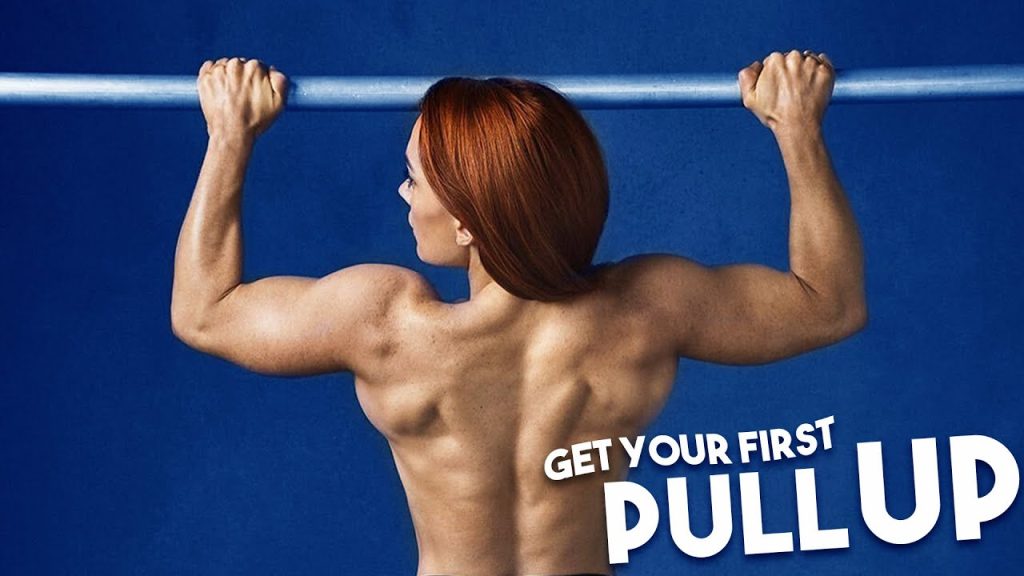
The pull-up is one of the most rewarding bodyweight movements you can learn — and for many people, one of the most intimidating. Today we will be sharing about working towards your first pull-up.
If you have been training for a while now but can’t seem to perform your first pull-up, this fitness article is for you. You are not alone, and more importantly, you are not stuck. The pull-up is a skill as much as it is a feat of strength — and like any skill, it can be broken down, practised, and mastered step by step.
Doing a pull-up is possibly one of the most difficult bodyweight movements for women to learn, and although achieving a pull-up may not be one of your fitness goals, they are actually an amazing exercise for upper back strength and endurance. Furthermore, it can improve your posture, shoulder health, muscular development, and help you move more weight safely.
However, many of us get intimidated by the thought of attempting a pull-up and failing, and as a result we avoid the exercise completely. That avoidance is the real enemy — not the bar. Well, we’re going to share some amazing tips that can help you gain confidence and achieve your first pull-up.
Before you begin, remember that every single person who can now knock out pull-ups started exactly where you are: unable to do one. The only difference between them and you is the process they followed. Here is that process.
1. Reduce Your Bodyweight
This may seem like a no-brainer, but a reduction in body weight will also mean that you will be pulling a lesser weight. Every kilogram you carry is a kilogram you have to lift off the floor. The less you weigh, the less absolute strength you need to complete the movement.
Similarly, if you’ve just accomplished 1 pull-up, you may notice that even a 1kg weight gain will make that pull-up much harder. Small changes in bodyweight have an outsized effect on this particular exercise because you are moving your entire body against gravity.
This does not mean crash-dieting to chase a pull-up. It means training with a slight calorie deficit is a sensible place for many people, especially if body fat is on the higher side. Be sure to get your body composition analysis to find out more about your body composition, so you know exactly where you are starting from and what to focus on.
2. Work on Different Parts of Your Back Muscles
Doing a pull-up requires a bunch of different muscles in your upper body, so the best way to achieve that pull-up is to strengthen each individual muscle instead of just thinking of the back muscle as a whole.
Just to list a few, a pull-up requires your middle and lower trapezius, rhomboids, pectoralis major and minor, deltoids, infraspinatus, latissimus dorsi, teres major and more. Each of these muscles has a specific job during the movement — some pull your arms down, some stabilise your shoulder blades, and some keep your body from swinging.
Hence, incorporating different back and upper body exercises to target the different areas of your back is imperative if you are trying to get your pull-up. Rows build the mid-back, lat pulldowns build the pull pattern, face pulls strengthen the rear delts and upper back, and core work keeps your body rigid through the movement. (Find out more about wrist pain here, since grip and wrist health matter for hanging work.)
3. Work on Pull-Up Progressions
Progressions are the key to building the strength and confidence you need for your first full pull-up. Start with the easiest variation and work your way up as you get stronger. Do not rush this ladder — every rung is doing its job.
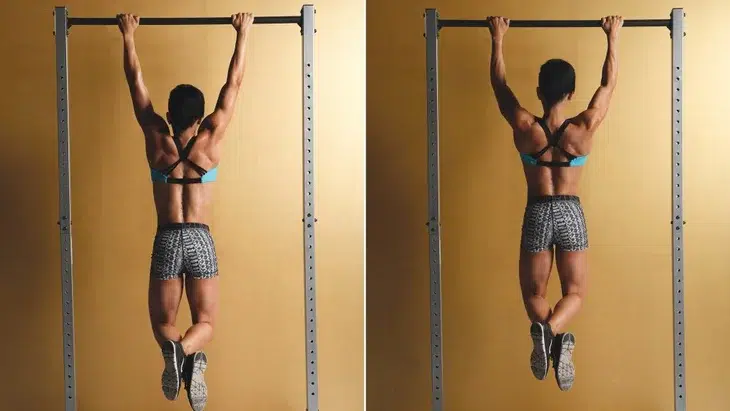
Dead Hangs / Hanging Shrugs
These require you to hang on the bar while keeping your core tight and shoulders retracted to minimize swinging on the bar. They build the grip strength and shoulder stability that every pull-up depends on. If you cannot hold a dead hang for 30 seconds yet, that is your first milestone.

Inclined Pull-Ups
Inclined pull-ups require your feet or heels to be on the ground while you pull your chest up to a low-positioned bar, using your lower body strength to assist you. This is a great first step because it lets you practice the pulling motion with less of your bodyweight. As you get stronger, move your feet further forward so more of your weight hangs on your arms.

Resistance Band Pull-Ups
Once your inclined pull-ups start to become easy, you then want to try working on resistance band pull-ups. Start off with a heavier resistance band and slowly work your way towards the lighter bands as you get stronger. These will help you to train the muscles needed to perform a pull-up without you having to pull your full body weight. Band thickness is your dial — thin down as you improve.
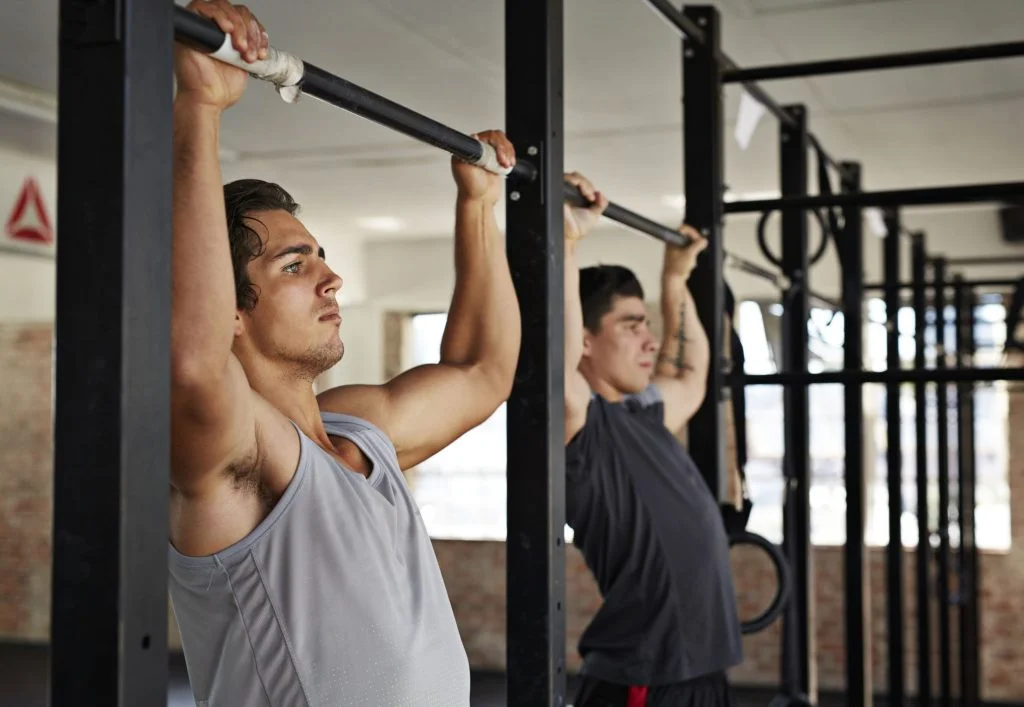
Negative Pull-Ups
Perform this by starting at the top range of the pull-up and slowly lowering yourself downwards. You can do this by stepping on a high box or jumping up into position. Try to slowly lower yourself down in 10 to 15 seconds, and repeat as many times as you can while conserving proper execution form. Negatives teach your body the movement pattern while building the exact strength you need for the concentric phase.
Try Working on a Chin-Up First
Most people find doing a chin-up easier than a pull-up. The difference between these is the way you grip the bar. With the chin-up you use more biceps, making it easier than a pull-up which requires more back. Performing a chin-up first will also give you more confidence that you can actually pull yourself up. Once you own a few chin-ups, start swapping some sets to the overhand grip.
How to Structure Your Pull-Up Training
Consistency beats intensity when it comes to pull-ups. Aim for two to three short sessions per week, with at least one rest day between them. Each session might look something like this:
- Warm-up: 5 to 10 minutes of light cardio plus shoulder and scapular mobility drills.
- Main work: 5 to 8 total sets of your current progression, resting 2 to 3 minutes between sets.
- Accessory work: rows, lat pulldowns, face pulls, and core work to support the movement.
- Track everything: write down how many reps or seconds you completed each session and aim to beat it next time.
Progress is rarely a straight line. Some weeks you will add reps easily, and some weeks you will feel stuck. That is normal. Keep chipping away, and the bar will move.
Common Mistakes to Avoid
- Rushing the progressions. Jumping straight to a full pull-up before your muscles are ready leads to frustration and injury risk.
- Swinging and kicking. Momentum hides weakness. Keep your body tight and let your back and arms do the work.
- Half rep ranges. A partial pull-up is not the same as a full one. Lower all the way down and pull all the way up.
- Gripping too hard. A death grip tires your forearms before your back gets the work it needs.
- Skipping recovery. Your back muscles grow when you rest, not while you train. Sleep and nutrition are part of the program.
Train with a Plan That Gets You There
There’s no one in this world who knows your body better than you. But if you ever need some guidance, RAW has your back. If you’re ready to revamp your lifestyle to focus on fat loss instead of weight loss, our personal training program can help you build the right workout regimens and nutrition plans.
To help you track your progress and measure your body fat percentage, our InBody 120 body composition test is also at your service — it gives you the data you need to know whether your bodyweight work is moving in the right direction.
You can change your life with just a click. Book a free consultation with us today and kickstart your workout sessions with the most competent personal trainers in Singapore.