
TL;DR:
- Personalized training addresses unique physiology and goals, producing better results for executives.
- Resistance training preserves lean muscle mass, enhances metabolism, and improves body composition.
- Private, tailored sessions optimize time, reduce injury risk, and drive long-term performance improvements.
You work long hours, you manage high-stakes decisions, and somewhere between board meetings and business travel, you’re supposed to find time to get fit. The frustration isn’t a lack of willpower. It’s that most fitness advice is built for someone else. Generic group classes, cookie-cutter online plans, and crowded commercial gyms were never designed for executives who need measurable results in limited time. Private personal training, grounded in exercise science and tailored to your exact physiology and goals, changes that equation entirely. This article breaks down the real, research-backed benefits of personalized coaching for fat loss, muscle preservation, and athletic performance, so you can stop guessing and start progressing.
Table of Contents
- Why personalization in personal training matters for executives
- Body composition: Fat loss and muscle preservation with resistance training
- Designing optimal training for executive results: Fatigue management and sustainability
- Athletic performance and targeted outcomes: Beyond fat loss and muscle gains
- Quick comparison: Private personal training vs. alternatives for busy professionals
- Our perspective: What most articles miss about high-performance personal training
- Take action: Experience Singapore’s best private personal training
- Frequently asked questions
Key Takeaways
| Point | Details |
|---|---|
| Tailored coaching matters | Personalized programs deliver superior results in fat loss, muscle preservation, and performance gains. |
| Resistance beats cardio-only | Resistance training better preserves muscle and enhances fat loss vs. diet or cardio alone. |
| Measure more than weight | Body composition and circumferences are more meaningful than scale weight alone. |
| Sustainability fuels progress | Effective training for executives requires fatigue management and flexibility for real long-term change. |
| Private training advantage | A distraction-free, tailored setting helps busy professionals achieve measurable, repeatable results. |
Why personalization in personal training matters for executives
With the stakes high for executives, let’s explore why individualized coaching is so effective.
Walk into any commercial gym in Singapore and you’ll see the same scene: rows of treadmills, generic workout posters on the wall, and people following programs they found online. Some of them are making progress. Most are not. The reason isn’t effort. It’s that exercise without personalization is a bit like taking someone else’s prescription medication. It might work, or it might set you back.
For high-performing professionals, the gap between a generic program and a personalized one is especially wide. Your body composition, injury history, stress levels, sleep quality, and performance goals are unique. A 45-year-old executive managing a regional portfolio has very different physiological needs than a 28-year-old athlete. Personalized training starts by acknowledging that difference and building from it.
What a proper personalized assessment covers:
- Current health status, including blood pressure, resting heart rate, and any existing conditions
- Movement screening to identify imbalances, compensations, or injury risk
- Body composition baseline, not just weight but fat mass versus lean mass
- Performance goals tied to real outcomes: fat loss percentage, strength benchmarks, or endurance markers
- Schedule constraints, stress load, and recovery capacity
This kind of intake process isn’t just a formality. It’s the foundation of a program that actually works. A holistic fitness approach considers the full picture of your health, not just what you can lift.
One of the most underappreciated benefits of personalized training is bespoke strategy. Fat loss requires a different stimulus than muscle building, and both require a different approach than improving your golf swing or your stamina for back-to-back travel days. When your trainer understands your goal at a granular level, every session is designed to move you toward it, not away from it.
“Calorie restriction without resistance training increases the risk of lean-mass decline. Tailored and functional strength programs increase both safety and adherence.” — Cleveland Clinic
This is a critical point. Many executives who try to lose weight through diet alone end up losing muscle along with fat. That’s not quality weight loss. It’s a metabolic setback that makes future fat loss harder and leaves you feeling weaker, not leaner.
Flexibility in scheduling is another factor that separates private training from group classes. When you’re flying to Jakarta on Tuesday and have a client dinner Thursday, your training program needs to adapt. Private trainers can restructure your week, adjust intensity based on your recovery, and keep you progressing without burning you out. This adaptability is something no group fitness class can offer.
The environment matters too. Private, appointment-only studios eliminate the noise, the waiting, and the social distractions that fragment your focus in commercial gyms. When you’re training beyond fat loss and working toward real performance outcomes, that focused environment isn’t a luxury. It’s a requirement.
Pro Tip: Before your first session with any trainer, ask them to explain how they’ll measure your progress over 12 weeks. If they can’t give you a specific answer, that’s a red flag.
Body composition: Fat loss and muscle preservation with resistance training
Once you understand the value of personalization, it’s crucial to focus on methods scientifically proven to deliver results.
Here’s a truth that most fitness marketing glosses over: not all weight loss is equal. Losing five kilograms on the scale means very little if three of those kilograms came from muscle. Muscle is metabolically active tissue. Losing it slows your resting metabolism, reduces your strength, and makes it harder to maintain fat loss over time. This is why body composition, the ratio of fat mass to lean mass, is a far more meaningful metric than body weight alone.
Resistance training is the single most effective tool for preserving lean mass during a fat-loss phase. A BMJ review confirmed that resistance training preserves fat-free mass and increases fat mass loss during weight-loss phases compared to diet alone. That’s not a minor difference. That’s the difference between looking and feeling leaner versus simply weighing less.
Key outcomes of resistance training for body composition:
- Preserves and builds lean muscle tissue during caloric deficits
- Increases resting metabolic rate by maintaining muscle mass
- Improves insulin sensitivity, which supports fat oxidation
- Enhances functional strength for everyday executive performance
- Produces visible changes in body shape, not just scale weight
The question of how to train for optimal body composition is where personalization becomes essential. For executives with limited time, the goal is maximum stimulus with minimum wasted effort. Compound movements like squats, deadlifts, rows, and presses recruit multiple muscle groups simultaneously, producing a hormonal response that supports both fat loss and muscle retention in a single session.
| Training approach | Lean mass preservation | Fat loss efficiency | Time per session |
|---|---|---|---|
| Diet only | Poor | Moderate | N/A |
| Cardio only | Low | Moderate | 45-60 min |
| Resistance training | High | High | 30-50 min |
| Resistance + cardio combined | Highest | Highest | 45-60 min |
The data supports a combined approach. Clinical research shows that combining resistance and aerobic training produces optimal body composition and physical-function benefits. For an executive, this might look like three resistance sessions per week with two shorter conditioning blocks integrated into the same sessions, rather than separate cardio days that eat into your schedule.
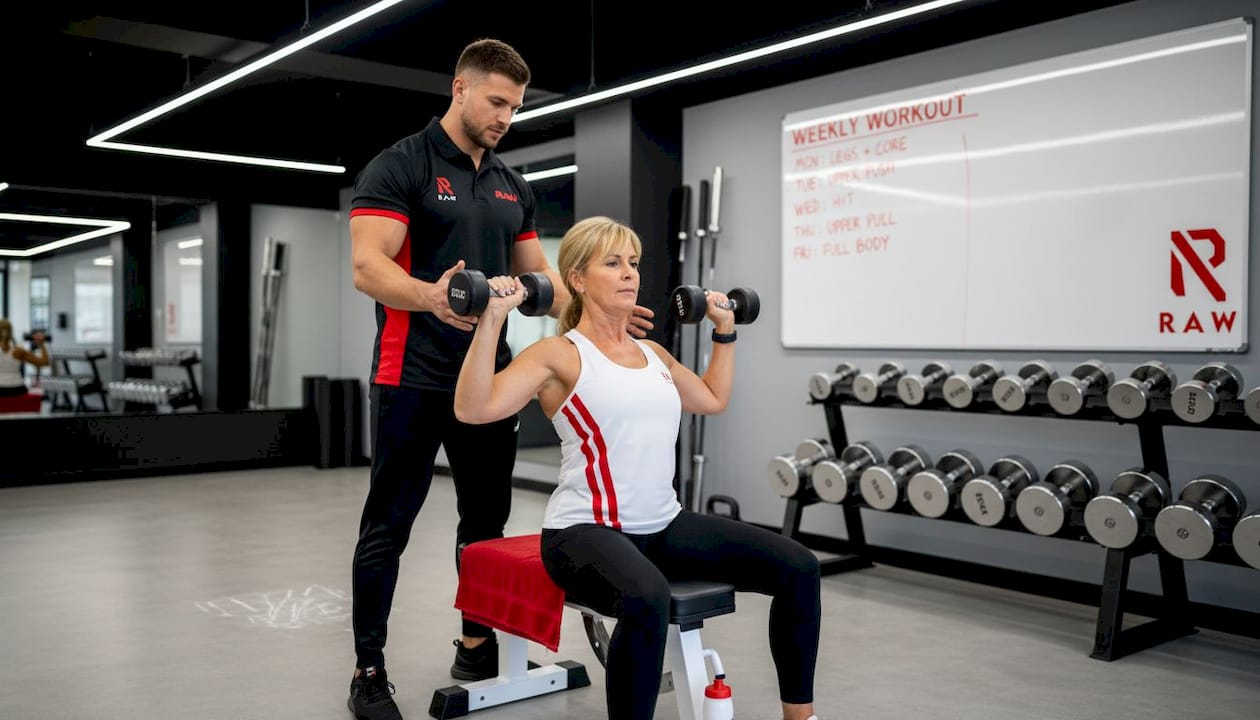
Understanding strength principles becomes especially important as you move past 40. Hormonal changes, reduced recovery speed, and accumulated wear and tear mean that the same program a 30-year-old uses won’t serve you as well. A skilled trainer adjusts load, volume, and exercise selection accordingly.
The concept of quality weight loss deserves more attention. When we talk about long-term fitness results, we’re talking about changes in body composition that stick, not rapid drops in scale weight that return within months. Chasing weight loss shortcuts might produce short-term numbers, but they rarely produce the physical confidence and sustained energy that executives are actually after.
Statistic to remember: Research shows that resistance training can increase fat mass loss by a meaningful margin compared to dieting alone, while simultaneously protecting the lean tissue that keeps your metabolism running efficiently.
Designing optimal training for executive results: Fatigue management and sustainability
While body composition is a key measure, how training is structured and sustained makes or breaks long-term success.
One of the most common patterns we see with high-achieving clients is this: they commit hard, train intensely for four to six weeks, then crash. Fatigue accumulates, motivation drops, and the program falls apart. This isn’t a character flaw. It’s a program design flaw. Sustainable progress requires deliberate fatigue management, and that’s a skill that separates exceptional trainers from average ones.
The four pillars of sustainable executive training:
- Periodization: Structured variation in training intensity and volume over time. This prevents adaptation plateaus and reduces injury risk. A well-periodized program cycles between higher-volume phases for hypertrophy, higher-intensity phases for strength, and deload weeks for recovery.
- Progressive overload: Gradually increasing the demand placed on your body over time. This is the fundamental driver of improvement. Without it, your body has no reason to change. With it, every session builds on the last.
- Recovery integration: Scheduling rest as deliberately as you schedule training. For executives managing high cognitive and emotional loads, recovery isn’t optional. It’s where adaptation happens.
- Exercise selection tailored to your body: Not every movement is right for every person. If you have a history of lower back issues, a trainer who insists on heavy barbell squats is not serving your best interest. Individualized exercise selection keeps you training consistently without accumulating damage.
“If a client cannot tolerate high intensity or has joint limitations, individualized exercise selection and recovery strategies are key for maintaining quality and adherence.” — Cleveland Clinic
This point is especially relevant for executives in their 40s and 50s who carry years of sitting at desks, traveling in cramped airplane seats, and managing physical stress without adequate recovery. The goal isn’t to train around your limitations forever. It’s to address them systematically while still making progress.
Finding your ideal trainer means finding someone who understands fatigue management as deeply as they understand exercise programming. The two are inseparable. A trainer who only knows how to push you harder isn’t equipped to get you to your goals safely.
Private environments play a direct role in sustainability too. When you’re not waiting for equipment, not navigating a crowded floor, and not distracted by conversations around you, your sessions are more efficient. You get more done in less time, with better focus and better form. That consistency compounds over months and years into results that are genuinely transformative.
Pro Tip: If you travel frequently, ask your trainer to build a home workout plan that mirrors your studio sessions. Continuity between travel and home training is one of the biggest factors in long-term success.
Athletic performance and targeted outcomes: Beyond fat loss and muscle gains
Maximizing performance is often as important as aesthetics for Singapore’s high performers.
Fat loss and muscle building get most of the attention in fitness marketing. But for many executives, the real goal is something more nuanced: more explosive energy in a round of golf, better stamina for a full day of back-to-back meetings, faster recovery from long-haul flights, or simply the physical confidence that comes from knowing your body is performing at its best.
These are athletic performance goals, and they require a different training lens.
Metabolic resistance training (MRT) is one of the most effective tools for developing this kind of functional athleticism. MRT combines resistance exercises with minimal rest periods, creating a training stimulus that builds strength, improves cardiovascular capacity, and enhances explosive output simultaneously. Research published in Frontiers in Physiology confirms that metabolic resistance training can improve explosive athletic outcomes, though the effects on aerobic capacity depend on protocol, which reinforces why individualized program design matters.
Executive performance goals that benefit from targeted training:
- Improved power output for sports like golf, tennis, or squash
- Greater stamina for long travel days and high-demand work schedules
- Faster cognitive recovery after physical exertion
- Better posture and reduced pain from prolonged sitting
- Enhanced sleep quality through regulated cortisol and physical fatigue
Cardio-only approaches fall short here. Running on a treadmill for 45 minutes does very little to develop explosive power, muscular endurance under load, or the kind of functional strength that translates to real-world performance. It has its place, but it’s not sufficient on its own for executives who want a performance edge.
Tracking progress accurately is also a critical component of athletic development. Body weight alone tells you almost nothing about whether your training is working. Research in Frontiers in Endocrinology highlights that fat-mass-to-weight-loss ratio and body circumference measurements are valuable tools for tracking training quality. These metrics reveal whether you’re losing fat, gaining muscle, or simply losing water weight, and they give your trainer the data needed to adjust your program intelligently.
| Performance metric | What it reveals | Why it matters for executives |
|---|---|---|
| Fat-mass-to-weight-loss ratio | Quality of weight lost | Confirms muscle is preserved |
| Body circumference | Regional fat distribution changes | Tracks visible body shape changes |
| Strength benchmarks | Neuromuscular progress | Correlates with real-world performance |
| Resting heart rate trend | Cardiovascular adaptation | Indicates recovery and fitness level |
Understanding the breakthrough benefits of private personal training means recognizing that the value extends well beyond aesthetics. When your body performs better, your mind performs better. That’s an edge most executives haven’t fully explored.
Quick comparison: Private personal training vs. alternatives for busy professionals
To wrap up the list, here’s a clear comparison to simplify your decision.
You have options. Group fitness classes, online coaching platforms, DIY gym memberships, and private personal training all occupy different positions in the fitness market. For a busy executive who needs measurable results, the right choice becomes clear when you compare them side by side.
| Feature | Private personal training | Group fitness classes | DIY gym membership |
|---|---|---|---|
| Program personalization | Full, individualized | None | Self-directed |
| Outcome tracking | Systematic and measurable | Minimal | Self-managed |
| Injury accommodation | Built into program design | Not possible | Guesswork |
| Schedule flexibility | High, appointment-based | Fixed class times | Open, but unstructured |
| Accountability | Direct, session-by-session | Peer-based, inconsistent | Self-reliant |
| Environment | Private, distraction-free | Crowded, social | Crowded, variable |
| Progress speed | Optimized for your goals | Average across group | Depends on self-knowledge |
The contrast is stark. Clinical evidence shows that personalized resistance training combined with aerobic modalities produces the best results for fat loss, muscle retention, and physical performance compared to generic one-size-fits-all plans. Group classes and DIY programs simply cannot replicate the individualization that drives those outcomes.
Why private training wins for executive professionals:
- Every session is designed around your specific goals, not a general population
- Your trainer adjusts in real time based on how you’re recovering and responding
- Outcome metrics are tracked consistently, so you always know if you’re progressing
- The private environment means you’re never waiting for equipment or managing social dynamics
- Injury history and joint concerns are addressed proactively, not reactively
The investment in private training is also an investment in time efficiency. When every session is optimized for your goals, you don’t need to spend hours in the gym to see results. Thirty to fifty minutes of focused, well-designed training produces more meaningful adaptation than ninety minutes of unfocused effort in a crowded facility.
Attaining your fitness goals requires more than showing up. It requires showing up with a plan that’s built for you, executed with precision, and adjusted as you evolve.
Our perspective: What most articles miss about high-performance personal training
Now that the evidence and options are clear, here’s our direct take from years in Singapore’s executive fitness scene.
Most fitness articles focus on motivation. Train harder. Stay consistent. Find your why. That’s well-intentioned advice, but it misses the real reason most high-achieving professionals stagnate: they’re working hard without measurable personalization, and they’re ignoring fatigue until it forces them to stop.
We’ve worked with executives who were doing everything “right” by conventional standards. They were showing up four times a week, eating reasonably well, and pushing through discomfort. But their results had plateaued because their program wasn’t evolving with them, and their recovery was never being managed. Willpower was never the issue. Program design was.
The uncomfortable truth is that private, results-driven training isn’t a luxury for people who want to feel good about spending money on fitness. It’s an accelerant for people who cannot afford to waste time on approaches that don’t work. When your schedule is demanding and your goals are specific, the margin for error is small.
We believe the future of executive fitness belongs to those who treat training as a strategic investment, the same way they approach talent, technology, or advisory services. You wouldn’t hire a generalist to solve a specialized business problem. The same logic applies to your body. Understanding what makes personal training an essential service is the first step toward using it properly.
Take action: Experience Singapore’s best private personal training
Ready to apply these lessons? Here’s how to take the next step.
If this article has clarified what’s been missing from your fitness approach, the next move is straightforward. At RAW Active, we work exclusively with clients who are serious about measurable outcomes. Our appointment-only studio at Orchard Towers gives you a private, fully equipped environment where every session is built around your goals, your body, and your schedule.
We start with a detailed assessment that covers body composition, movement quality, and performance goals. From there, we design a program that evolves with you, whether you’re focused on fat loss, muscle building, or athletic performance. Our personal training approach is grounded in exercise science, not trends. We also integrate training and nutrition guidance to ensure your results are supported inside and outside the studio. If you’re ready to experience what top personal training in Singapore actually looks like, we’re ready to show you.
Frequently asked questions
Does resistance training help with fat loss if I am already dieting?
Yes, adding resistance training to dieting helps preserve muscle and increases fat loss compared to dieting alone. A BMJ review confirms that resistance training preserves fat-free mass and increases fat mass loss during weight-loss phases.
What is the best way to track the quality of weight loss?
Use measurements like body composition and fat-mass-to-weight-loss ratio to assess weight-loss quality, not just scale weight. Research in Frontiers in Endocrinology confirms that body circumference measurements and fat-mass-to-weight-loss ratio are valuable tools for evaluating training quality.
Can personal training be adjusted for joint pain or injury recovery?
Yes, individualized personal training can adjust exercise selection and recovery strategies to accommodate injuries or joint concerns. Cleveland Clinic guidance notes that individualized exercise selection and recovery strategies are key for clients who cannot tolerate high intensity or have joint limitations.
How do private sessions help busy executives see better results?
Private sessions personalize programming and create a distraction-free environment, supporting focus, accountability, and measurable progress. Without waiting for equipment or managing group dynamics, your time in the studio is fully optimized toward your specific goals.
Is cardio necessary if I want muscle gains with fat loss?
Combining resistance training with aerobic exercise yields optimal body composition results for fat loss and muscle preservation. Clinical research shows that a combined approach produces the best outcomes for both body composition and physical function.