
Most busy professionals spend hours following generic fitness routines, yet research shows that custom strength programs deliver significantly better results with less risk and more consistent gains. If you are an executive or professional in Singapore, you already know that your time is your most valuable resource. Spending it on a program that was not built for your body, your schedule, or your goals is not just inefficient. It is a missed opportunity. Personalized strength training changes that equation entirely, and the evidence behind it is compelling enough to make you rethink everything you thought you knew about getting stronger.
Table of Contents
- The science behind personalized strength training
- Core principles: How personalization works in practice
- The evidence: Why personalization outperforms generic routines
- Personalized training for Singapore professionals: Practical considerations
- Consistency and progression: The keys to lasting results
- Why individualized strength training is the edge most executives overlook
- Level up your results with tailored strength training in Singapore
- Frequently asked questions
Key Takeaways
| Point | Details |
|---|---|
| Personalization delivers better results | Tailoring your strength program maximizes gains, reduces injury risk, and fits your life. |
| Science-backed strategies matter | Research proves that individualized plans outperform generic routines for strength and recovery. |
| Consistency beats complexity | Regular, repeatable sessions done well have more impact than chasing perfect numbers or elaborate protocols. |
| Professional guidance is priceless | Combining human expertise with technology ensures personalized progress and safer outcomes. |
The science behind personalized strength training
Now let’s break down what makes personalized strength training different from the generic plans you see everywhere.
At its core, personalized strength training customizes load, volume, frequency, exercise selection, and progression to your individual goals, experience level, recovery capacity, and available equipment. This is not simply swapping one exercise for another. It is a complete rethinking of how a program is designed, built, and adjusted over time to serve one specific person: you.
Traditional gym programs follow a one-size-fits-all logic. They assume that if a protocol works for a sample population, it will work for everyone. That assumption breaks down quickly when you factor in the real differences between individuals. A 45-year-old executive managing high stress and limited sleep has fundamentally different recovery needs than a 25-year-old athlete training twice a day. A program that ignores those differences is not just suboptimal. It can be counterproductive.
ACSM 2026 guidelines emphasize individualized programming over rigid protocols, prioritizing consistency and full range of motion (ROM) as the primary drivers of sustainable progress. Secondary variables like exact rep ranges or specific exercise order are flexible and should adapt to the individual. This is a significant shift from older thinking that treated programming like a fixed recipe.
Here is a clear comparison of what separates the two approaches:
| Feature | Standardized program | Personalized program |
|---|---|---|
| Exercise selection | Fixed for all users | Chosen based on goals and mobility |
| Load and volume | Predetermined | Adjusted to recovery and performance |
| Progression model | Linear, time-based | Autoregulated, performance-based |
| Injury risk management | Generic | Individualized screening and adaptation |
| Schedule flexibility | Rigid | Built around your life |
The benefits of getting this right are measurable. Personalized programs consistently produce better strength gains, superior hypertrophy (muscle growth), improved athletic performance, and a meaningfully lower injury risk compared to standardized routines. For professionals who cannot afford weeks off due to a preventable injury, that last point alone justifies the investment.
“Individualization is not a luxury in strength training. It is the mechanism through which real, lasting progress is made.”
Core principles: How personalization works in practice
With the science in mind, how do trainers and technology actually turn this into a tailored plan for you?
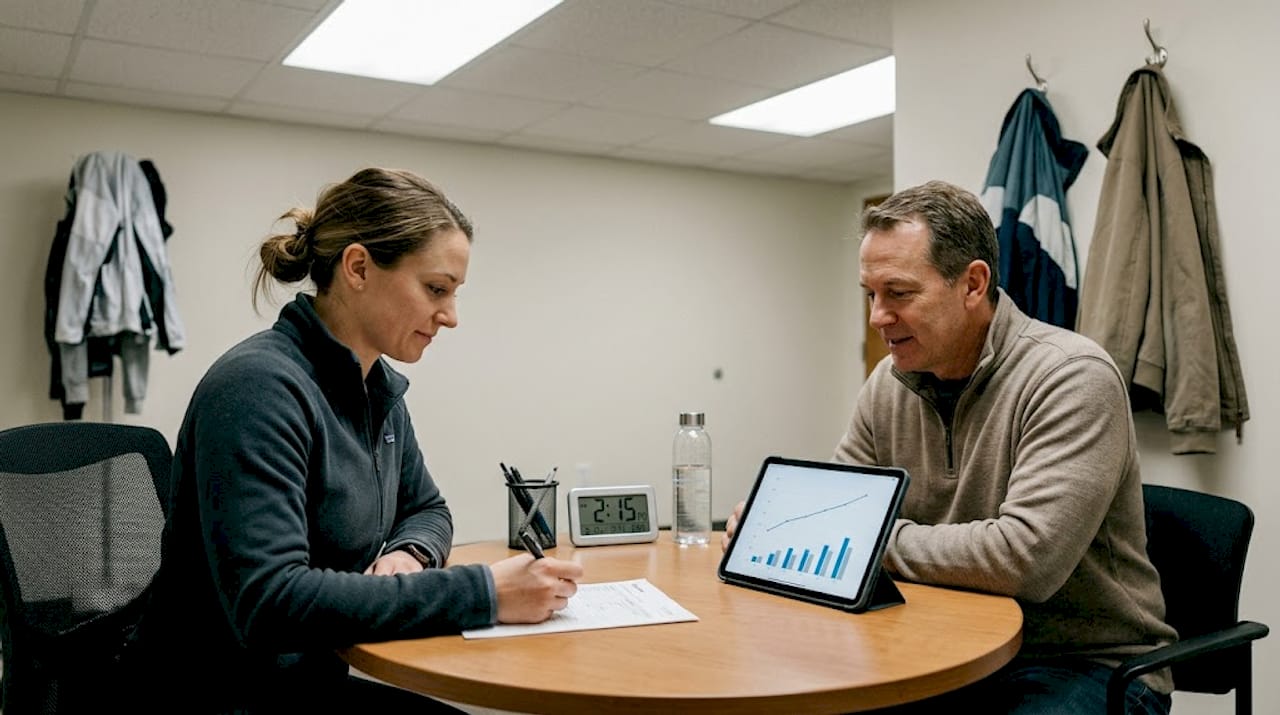
The process begins with a thorough initial assessment. Your goals, current fitness level, training history, available equipment, weekly schedule, and recovery capacity all feed into the design of your program. Key variables like goals, schedule, equipment, experience, and recovery determine the load, reps, sets, and progression model that will work best for you. Skip this step and you are essentially guessing.
Here is a sample personalization matrix that shows how different inputs lead to different prescriptions:
| Goal | Primary input | Training prescription |
|---|---|---|
| Fat loss | High stress, limited time | 3x/week full-body, moderate load, shorter rest |
| Muscle building | Moderate recovery, 4 days available | Upper/lower split, progressive overload focus |
| Athletic performance | Strong base, sport demands | Periodized plan with power and conditioning |
| Injury rehabilitation | Pain history, movement limits | Corrective exercises, low load, high control |
Once the assessment is complete, building your program follows a logical, stepwise process. Here are five practical steps:
- Define your primary goal with specificity. “Get stronger” is not a goal. “Increase my deadlift by 20kg in 16 weeks” is.
- Assess your starting point honestly, including movement quality, current strength levels, and recovery patterns.
- Select exercises that match your mobility, equipment access, and goal requirements.
- Establish your starting load and volume conservatively. It is far better to progress from a manageable baseline than to start too heavy and stall.
- Build in a progression model that adds reps first, then load, then sets as you adapt. This stepwise approach prevents stagnation and keeps the stimulus fresh.
A growing number of programs now integrate hybrid AI-human coaching, where technology handles data tracking and plan adjustments while a qualified coach provides judgment, safety oversight, and motivation. This combination is particularly effective for personalized strength training for women and other populations where nuanced coaching decisions matter most.
Pro Tip: Autoregulation, meaning adjusting your training load based on how you actually feel that session, consistently outperforms rigid adherence to a preset number. Completing every session at 80% effort beats missing sessions chasing 100%. Session completion is the real metric.
The evidence: Why personalization outperforms generic routines
The value of personalization comes into focus when you examine the hard numbers and performance metrics.
Research published in peer-reviewed journals makes a strong case. Personalized resistance training delivers measurable advantages across populations, including a 1.92kg improvement in handgrip strength, an 18.11% increase in functional muscle performance, and a 43% reduction in injury rates compared to generic routines. These are not marginal gains. They represent a meaningful difference in how your body performs and recovers.
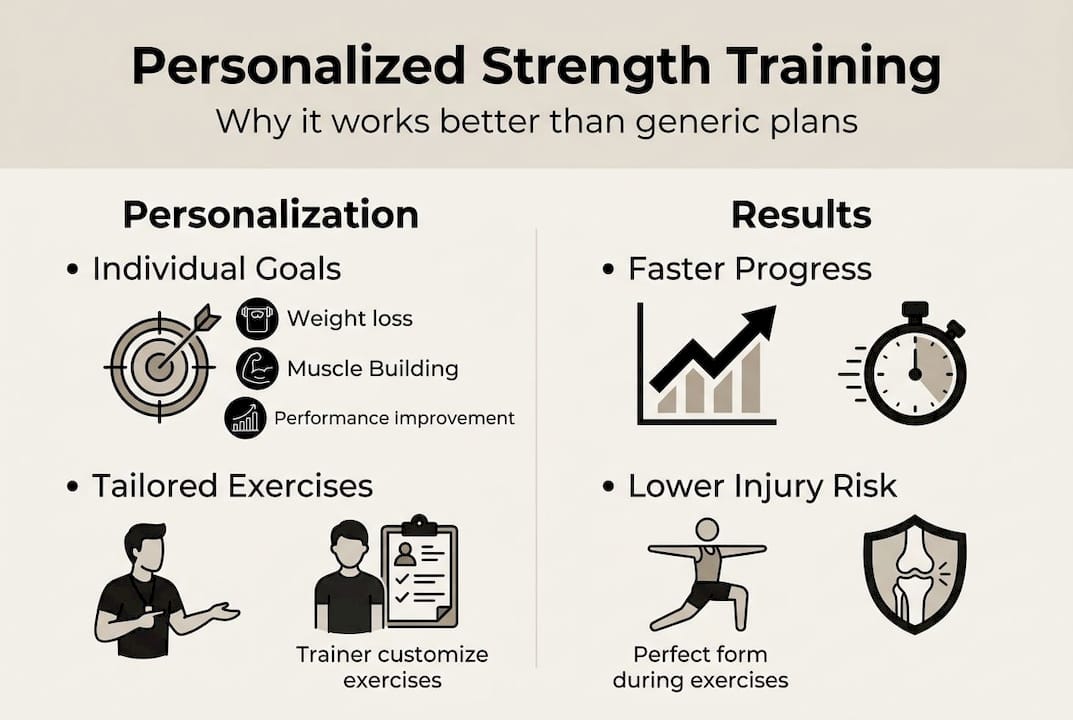
Further evidence from deep reinforcement learning (DRL) personalization research shows that individualized programs yield 12.3% performance gains and 43% fewer injuries, with the best outcomes occurring in well-resourced, hybrid coaching environments. For Singapore’s professionals, who often have access to premium facilities and expert trainers, this is particularly relevant.
Here is a quick summary of where personalized programs consistently outperform generic ones:
- Strength gains: Faster and more sustained improvements in one-rep max and functional strength
- Muscle function: Greater improvements in movement quality and daily performance
- Injury prevention: Significantly lower rates of overuse and acute training injuries
- Adherence: Higher long-term program completion rates due to realistic, goal-aligned design
- Recovery: Better management of fatigue and readiness, especially for high-stress individuals
“A 43% reduction in injury risk is not a statistic. It is the difference between staying on track for a full year and spending three months sidelined.”
For busy executives, the practical implications are clear. You are not training to win a competition. You are training to get stronger fast, stay healthy, and perform at your best in every meeting, every decision, and every demand your career places on you. A program designed around your specific physiology and lifestyle does that far more effectively than any generic plan.
The research also highlights something important for high-performing adults: the gap between personalized and generic programs widens over time. In the first few weeks, almost any program produces results because your body is adapting to a new stimulus. But after 8 to 12 weeks, generic programs plateau while individualized ones continue to drive progress because they are built to evolve with you.
Personalized training for Singapore professionals: Practical considerations
Understanding the scientific backing leads to the question: how can Singapore professionals actually apply all this in a way that fits their demanding lives?
The biggest barriers we hear from executives are time constraints, the distraction-heavy environment of commercial gyms, and difficulty maintaining motivation when results stall. These are real problems, and they all have practical solutions within a well-designed personalized program.
Strength training in Singapore has evolved significantly, with premium, appointment-only studios offering environments specifically designed to remove those barriers. Here is what a high-quality personalized program for a Singapore professional typically includes:
- Tailored scheduling: Sessions built around your calendar, not the other way around
- Expert supervision: A qualified coach who monitors your form, adjusts loads in real time, and keeps you accountable
- Recovery integration: Active management of sleep, stress, and nutrition as part of the training plan
- Smaller exercise menus: Focused on a core set of movements that deliver maximum return, reducing decision fatigue
- Data-driven feedback: Regular body composition analysis and performance tracking to show you exactly where you are progressing
One often-overlooked advantage of smaller exercise menus is that they improve skill acquisition. When you repeat the same high-value movements consistently, your neuromuscular efficiency improves rapidly. You get stronger not just because you are adding load, but because your nervous system is becoming more efficient at producing force. This is why functional versus traditional strength training comparisons matter for professionals who want real-world performance, not just gym numbers.
Pro Tip: Integrating sleep and stress tracking into your training plan is one of the highest-leverage moves a professional can make. When your coach knows you had four hours of sleep and a high-pressure week, they can adjust your session to still deliver a productive stimulus without pushing you into overtraining. That kind of responsiveness is impossible with a generic program.
Adherence is ultimately the deciding factor. A perfect program that you follow inconsistently will always lose to a good program that you complete every session. Personalized programs win here because they are realistic, enjoyable, and built around your actual life.
Consistency and progression: The keys to lasting results
To bring it all together, it is time to focus on the make-or-break factor for high-level results: your ability to stick to the program.
ACSM 2026 guidelines are clear on this point. Consistency, defined as at least two sessions per week targeting all major muscle groups, combined with progressive overload and full range of motion, outperforms any complex protocol that is followed sporadically. The principle is simple but powerful: showing up regularly beats chasing perfection.
Progression in a personalized program follows a logical, sustainable path. Add reps first. Once you can complete the top of your rep range with good form, increase the load. When you can handle that load across all sets, consider adding a set. This stepwise model prevents the common mistake of jumping load too quickly, which is one of the primary causes of stalled progress and injury in self-directed training.
Premium environments play a meaningful role in supporting consistency. When your training space is distraction-free, your equipment is always available, and your coach is expecting you at a specific time, the psychological barriers to showing up drop significantly. Accountability is not a soft benefit. It is a structural advantage.
Here are five strategies for staying on track with personalized training over the long term:
- Schedule sessions like meetings: Block the time in your calendar and treat it as non-negotiable.
- Track your performance: Keep a simple log of loads, reps, and how you felt. Progress is motivating.
- Communicate with your coach: If life gets in the way, adjust the plan rather than skipping entirely.
- Focus on the process, not the outcome: Strength is built session by session, not in a single workout.
- Celebrate small wins: A new personal best on a lift, improved posture, or better sleep are all meaningful markers of progress.
For strength training over 40, these principles become even more important. Recovery slows, stress accumulates differently, and the cost of inconsistency is higher. A personalized approach that respects those realities is not optional. It is essential.
“Sessions completed consistently at a good effort level will always outperform sessions chased at perfect intensity. The best program is the one you actually do.”
Why individualized strength training is the edge most executives overlook
Having explored the how and why of personalization, here is what experience shows about its real impact, especially for high-stakes careers.
We work with executives who are genuinely committed to their health. They are disciplined, motivated, and willing to put in the work. But many of them arrive clinging to the idea that working harder is the answer. They follow the same generic program they found online, push through fatigue, and wonder why they are not progressing or why they keep getting hurt.
The false economy of cookie-cutter routines is real. You spend more time, accumulate more unnecessary fatigue, and get less return. Individualization reclaims those hours and redirects your effort toward what actually moves the needle for your specific body and goals. We have seen executives improve their cellular health through strength training and report sharper cognitive performance, better sleep, and more energy for their teams simply by training smarter, not harder.
Pro Tip: For leaders, the metrics that matter most are not just kilograms on the bar. Track your recovery quality, your cognitive performance on high-demand days, and your energy levels across the week. These are the real returns on your training investment.
Level up your results with tailored strength training in Singapore
Ready to experience the benefits of truly individualized strength training? Take your next steps here.
At RAW Active, we built our studio around one belief: that personal training is an essential service, not a luxury. Our appointment-only, distraction-free environment at Orchard Towers means your session is always focused, your equipment is always ready, and your coach is always present.
We combine personal training and nutrition into a fully integrated approach that adapts to your goals, your schedule, and your recovery needs. Whether you are building strength, managing an injury, or optimizing performance, our team holds degrees in sports science and certifications in Applied Functional Science to back every decision. Explore what premium training near Ngee Ann City looks like when it is built entirely around you.
Frequently asked questions
What are the main benefits of personalized strength training for busy executives?
Personalized programs increase efficiency, reduce injury risk, and optimize strength and functional gains in less time compared to generic routines. Research confirms that individualized programs yield 12.3% better performance outcomes and 43% fewer injuries.
How often should I do strength training for best results?
According to ACSM 2026 guidelines, consistency with at least two sessions per week targeting all major muscle groups is the primary driver of sustainable progress.
How is progression managed in a personalized strength program?
Progression follows a stepwise model: increase repetitions first, then the load, and finally the number of sets, always based on your actual performance and recovery each session.
Is AI coaching as effective as working with a human trainer?
AI can assist with plan adjustments and data tracking, but ACSM 2026 guidelines indicate that human oversight remains essential for safety, nuanced judgment, and meaningful accountability.
Can personalized strength training help with injury recovery?
Yes. Individualized resistance training delivers a 43% reduction in injury risk and can be precisely adapted to support safe, effective rehabilitation without compromising long-term progress.
Recommended
- Unlock Your Strength Potential: Effective Techniques for Quick Gains – Raw Active
- Personalized Strength Training for Women: The RAW Active Approach – Raw Active
- Strength Training: The Ultimate Fitness Regime – Raw Active
- Comprehensive Strength Training Guide – Raw Active
Article generated by BabyLoveGrowth

- Key Personal Training Benefits for Long-Term Results - April 26, 2026
- Unlock Your Potential with Personalized Strength Training - April 25, 2026
- Selecting the Best Private Gym Facilities in Singapore - April 25, 2026